Dynasty® 400
Dynasty 400 series AC/DC, TIG/Stick capabilities. Welds up to 5/8 in. material. LCD interface, locks and limits, and program memory.

At 35,000 feet in the air, there is no room for error when it comes to airplane fabrication. This makes the work of the welding operation at the Safran Nacelles Group in Burnley, England, critical.
The facility manufactures thin-gauge titanium components used in nacelles — the parts on an aircraft that protect the engine. The Burnley location is part of Safran, the world’s third-largest aerospace organization, which produces parts for customers across the globe.
“We work to a lot of internal standards with high quality requirements,” says Mark Durkin, the welding specialist who oversees weld quality at the Burnley plant. “Tolerances are very stringent.”
As part of those rigorous standards, the facility is accredited by NADCAP (National Aerospace and Defense Contractors Accreditation Program) and undergoes regular audits of their weld quality management systems.
“The welding quality side is a very big part of the business, especially when it’s aircraft components. We have a nondestructive testing site and everything does go through there to get inspected,” says Chris Hill, manufacturing manager. “What sets us apart from other suppliers is our work with thin-gauge titanium. Not many facilities can weld down to 0.4 titanium, so obviously our skillset and our welders support that skill.”
The titanium parts welded at the facility range from 0.4 millimeter to 1.6 millimeter in thickness. With material that thin, there is potential for weld distortion when heat input isn’t properly controlled.
The Burnley facility experienced issues with distortion on a specific component for one customer — resulting in added time for rework and higher costs for scrapped parts. They were able to solve the problem with a switch to the Miller® Dynasty 400 TIG welder, a continuation of their long-standing relationship with Miller welding power sources and the Dynasty family of machines.
One specific component for a customer was causing issues due to the very tight geometric tolerance, the amount of welding required on the part and the area on the part where the welding was needed. There were problems with weld distortion, causing a lot of rework and parts being scrapped.
In an effort to fix the problems, the Burnley welding operation tested the Dynasty 400 TIG welder with that specific part. The Dynasty 400 provides a higher pulse rate for pulsed TIG welding — allowing operators to eliminate the weld distortion they were seeing with that part.
“The Dynasty 400 has a maximum of 5,000 pulses per second, compared to the other machine that has 500 pulses per second,” Durkin says. “The higher pulses allowed us to lower the heat and the distortion.”
Before switching to the Dynasty 400 for that part, the rework in the sheet metal operation was taking 45 minutes to an hour to remove the distortion on each part.
“We saw a massive time savings,” Durkin says.
It wasn’t only the time savings. Passing quality testing on the first try for each part helped them hit quality goals and reduce scrap waste and costs.
“We could hit first-time yield on every part rather than scrapping some off due to weld deformation,” Hill says. “That’s really key. If we have any scrap fallout due to a geometric issue, we’ve then got to replace that part through our production plan, so the Dynasty helped alleviate that problem.”
Miller Dynasty machines are a go-to welding power source for many in the aerospace industry because they offer high weld quality and arc control can be dialed in very tightly.
The welders and managers at the Burnley plant have been very happy with the entire Dynasty family of welders that they have used for years at the facility, including the Dynasty 210 and Dynasty 400.
When they choose welding power sources for the operation, they look for machines that are easy to set up and use, are energy efficient, have the necessary power and duty cycle, and offer excellent reliability.
“We have seen many benefits using Miller Dynasty machines — everything from the interface that makes it easy for the welder to change settings between jobs to the excellent reliability and quality results,” Durkin says. “When we bring a new person in, there's very little training on the machine due to how user-friendly it is. So basically, the person can go straight into welding operations.”
Because the facility welds on a range of material thicknesses for some components, it’s important to have welding power sources that allow operators to easily change parameters or save welding programs for different components.
“We use complex jigs here at Safran,” says TIG welder Michael Whittaker. “With Dynasty welders, you can change the parameters very easily and very precisely, which is what you need in aerospace.”
And the similar interface among the different Dynasty models helps reduce training time for new welders.
“I’ve used different welders before and they’re very intimidating when you look at it. With the Dynasty, it’s formatted beautifully,” Whittaker says. “Everything is there. When I need to change something, it’s so simple.”
Durkin sees the newly updated Dynasty 210 TIG welder fitting in nicely with the welding lineup used at the Burnley facility. The new interface on the Dynasty 210 features a color LCD display that provides visual feedback on how adjustments will affect the welding arc. This helps welders understand the arc and how it’s performing. The machine can also save up to 99 weld programs in memory and has a locks and limits feature that helps control welding parameters being used — to minimize deviation from the welding procedure specifications.
“With locks and limits, the welder is sure he’s welding with the correct parameters, and that hopefully helps us reduce scrap and potential rework,” Durkin says. “Also, for audit purposes, it allows us to show that he’s operating within specifications for each product.”
In the years they have used Miller equipment at the Safran Burnley facility, they’ve never had a breakdown or downtime due to machine reliability issues. This helps the operation stay on time with customer projects and take on more work.
“That’s absolutely critical. We have a production plan to meet each week and when we have reliable equipment, it all goes toward hitting that plan,” Hill says. “We’ve had zero issues, zero downtime. We have tried alternatives from different suppliers and they have not met the quality standards. Every welding bay we have has a Miller welder in there.”
Dynasty 400 series AC/DC, TIG/Stick capabilities. Welds up to 5/8 in. material. LCD interface, locks and limits, and program memory.
Dynasty 210: 110-240V. Welds up to 1/4 in steel/aluminum. LCD, Locks, Program Memory.
For the Beets and Schnabel crews on Discovery Channel’s “Gold Rush,” mining can be a 24/7 operation — with millions on the line.
Deltaweld® 350 with Intellx™ Elite offers a user-friendly screen, eliminating guesswork and boosting productivity. Discover Miller’s intuitive welding technology.

Learn how the Safran Nacelles Group reduced weld distortion and rework when TIG welding titanium with a switch to the Miller® Dynasty 400 TIG welder.
Structural welding codes in earthquake-prone Seattle are stringent. Apex Steel delivers code-quality welds efficiently with Miller technology.

Boilermakers Local 92 needed to train new members on new welding processes - faster. Advanced welding processes and new technology were key.
Wheeler's fleet optimizations transformed technicians into a resilient service force with improved weld quality, reduced idle time, extended truck life, and safety.

Dobbs Equipment uses the HDI Air Pak to streamline repairs and reduce downtime at a high-output sand mine.

Switching between TIG and stick welding polarity can be a time consuming process. Technology from Miller makes it much simpler for NAES.

Houston fabrication facility Exterran greatly improved production and reduced defect rates with PipeWorx and RMD® welding process.

Learn how Komatsu improved speed and efficiency by adopting SubArc Hercules, enabling the Longview team to cut weld time and stay ahead of demand.
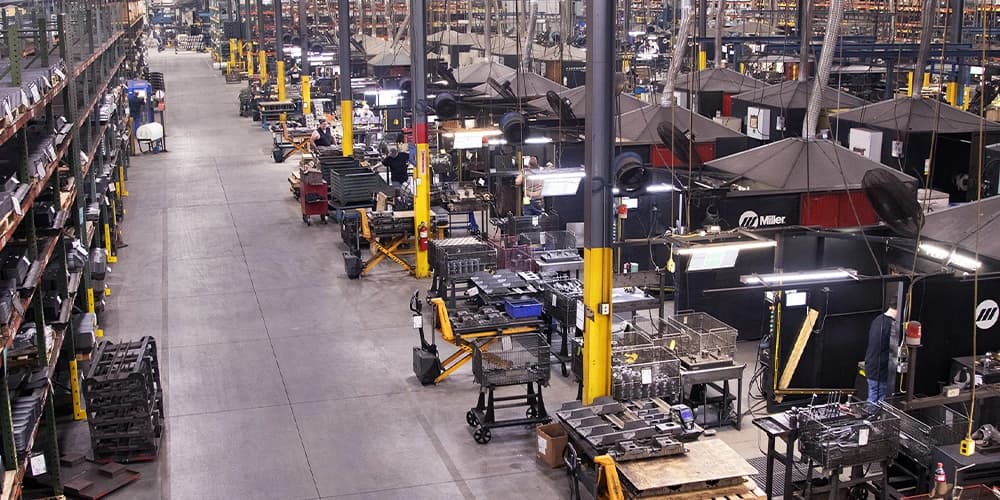
Discover how B&W Trailer Hitches transformed their manufacturing capabilities with Miller® PerformArc™ robotic welding systems. Learn how automation drives quality and efficiency — see what it could do for your operation today.

See how Hartnell College brings real-world welding automation into the classroom to meet evolving manufacturing workforce needs.

Repairs on a mining site are a daily occurrence. The Schnabel crew on "Gold Rush" uses reliable Miller equipment to keep operations running.
Uncover how the Miller team helped AGCO improve operator efficiency and ease while decreasing defects in their stainless steel welding operations.
Ascendum’s fleet overhaul with Miller EnPak® A60 units cut costs, boosts uptime and empowers technicians to deliver superior service.

Dynamic Manufacturing transformed their welding automation speed and quality using IntelliPath™ technology. See the impact on their operational success.
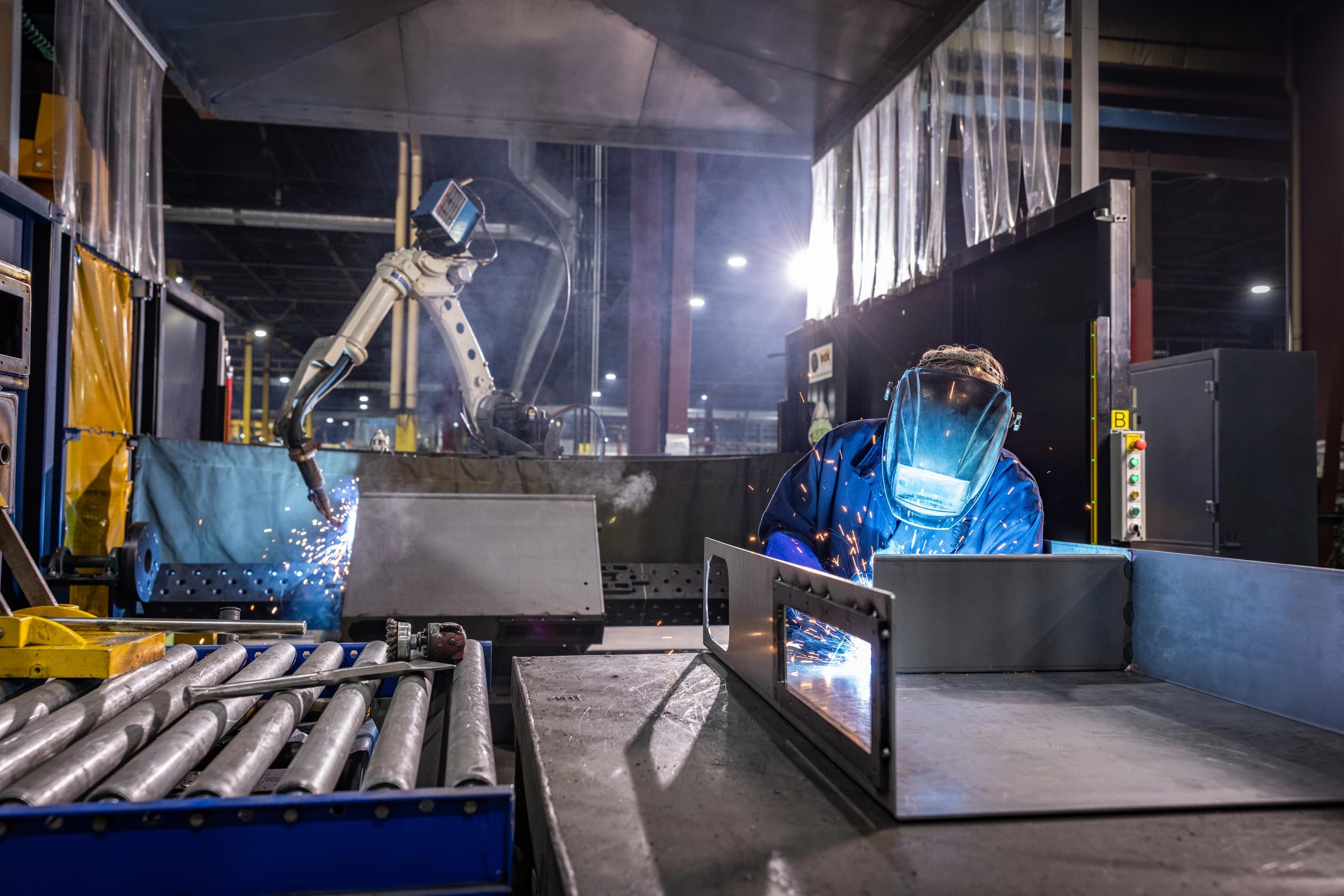
See how IFH Group used robotic welding automation and offline programming to increase throughput 25 to 30 percent on a family of larger tanks.

Learn how Team Industries created their own in-house welding training to address the shortage of skilled welders in the workforce.

Discover how new welding technology helped this racing organization boost productivity and long-term growth. Learn how they found success.

Take a look inside two different models of welder training at Tulsa Welding School and Blinn College and how they use Miller® welding equipment.

Henderson Products relies on the Deltaweld system and Intellx™ wire feeders with pulsed MIG welding to reduce training time and spatter.

G.G. Schmitt & Sons saves time and money welding anodized aluminum with Miller® Dynasty® 400 TIG welders, cutting hours of rework.
DE-CAL, Inc., relies on Miller equipment and technology to become one of the premier mechanical contractors in its region.

A change to Miller® FILTAIR® fume extraction systems helped decrease weld fume exposure and improve productivity for American Seating employees.

Implementing Miller® FILTAIR® MWX Mobile Fume Extractor helped improve air quality and productivity for Muscle Car Restoration employees.

A welding process change allowed Dixie Mechanical to eliminate back purging and double the number of welds completed every day.
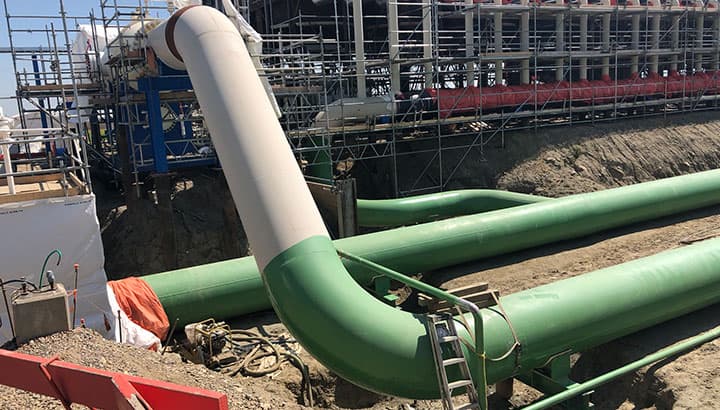
TC Energy switched from TIG and stick welding to wire processes for large-bore pipe on several projects and greatly improved productivity.

Mexia High School welding students enjoy hands-on experience with Miller® equipment and training resources.
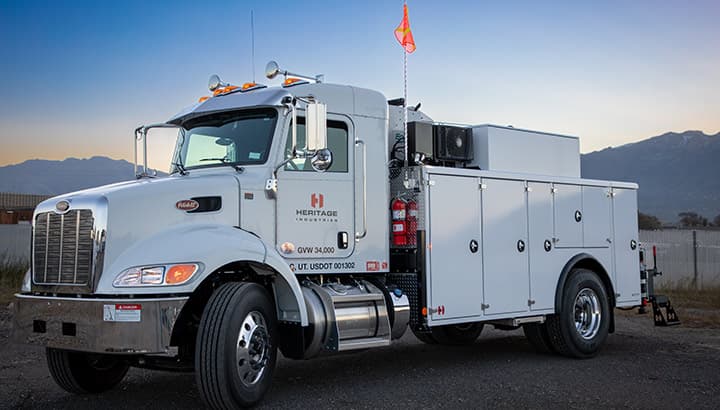
Wheeler CAT significantly reduced engine idling, to an average of 1% on a truck with a fully integrated cab heating and cooling system.