
Article
Advanced Aluminum Welding Techniques: MIG and TIG Tips and Complex Answers
Get advanced aluminum welding tips in this Q&A. Move past the basics and tackle the challenges of welding aluminum in industrial applications.
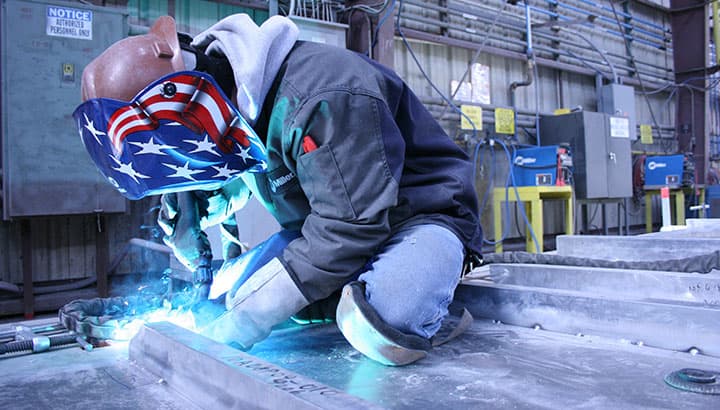
Aluminum continues to be a staple in industries ranging from aerospace to shipbuilding, as well as trailer fabrication. Its corrosion resistance and strength are both assets that make it desirable for applications encountering moisture and/or those requiring lighter weights.
When it comes to welding the material, controlling heat input is key. Aluminum transfers heat away from the weld at a faster rate than many materials (like steel), making it more difficult to establish a weld puddle. Too, because the material has a relatively low melting point, it’s prone to burn-through and warping on thinner sections — there simply isn’t enough mass to transfer the heat.
Other challenges when welding aluminum include:
For all of these reasons, the TIG or GTAW process is often preferred for welding aluminum, since it offers good control over the heat input and weld placement. The process, however, is slow and often difficult to train welding operators to use.
To help gain greater efficiencies, pulsed MIG welding is an excellent alternative. It also offers marked advantages over a traditional spray transfer MIG process sometimes used for welding aluminum, particularly in its ability to improve quality.
Pulsed MIG welding is a modified spray transfer process, in which the power source switches between a high peak current and a low background current between 30 to 400 times per second. During this switch, the peak current pinches off a droplet of wire and propels it to the weld joint. At the same time, the background current maintains the arc but has such a low heat input that metal transfer can’t occur. This action differs from a standard spray transfer process, which continuously transfers tiny droplets of molten metal into the weld joint. It also allows the weld puddle to freeze slightly to help prevent burn-through.
Aluminum applications that are prone to weld defects such as lack of fusion or porosity, or problems like burn-through, spatter or warping are good candidates for pulsed MIG welding. The lower heat input generated by the process offers similar advantages found when TIG welding. It also provides the good penetration and fusion associated with a traditional spray transfer process.
Pulsed MIG welding can be used for welding both thick and thin aluminum. On thicker sections, it helps minimize downtime for repositioning parts — the process generates a cooler weld puddle than a traditional spray transfer process, making it usable in all positions.
On thinner sections of aluminum, it minimizes the opportunity for burn-through and reduces the risk of warping by controlling the heat input. This allows for the use a larger diameter wire (up to 3/64 inch), which increases deposition rates and productivity. The operator can put more metal in the joint in less time — without adding excessive amounts of heat. In many cases, pulsed MIG welding can also allow for faster wire feed and travel speeds, again increasing productivity. At the same time, the process simultaneously reduces heat input, decreasing residual stress and lowering the opportunity for distortion.
The pulsed MIG process provides good directional control over the weld puddle, making it easier for new welders to learn the process and create welds with good bead appearance. Additionally, it works well for bridging gaps in the weld joint. Pulsed MIG can also aid in the cleaning action required to remove the aluminum oxide layer on the surface. Note, however, that pulsed MIG welding is not a substitute for good pre-welding practices such as removing the oxides with a designated stainless steel wire brush or another approved means.
Other advantages to pulsed MIG welding include the ability to control the bead profile, as well as improved arc starting and stopping.
With some power sources offering the pulsed MIG process, welding operators can adjust the width of the arc cone. Doing so helps them tailor the bead profile to the application. For example, wider weld beads can improve tie-in on both sides of a joint. Conversely, a narrower bead helps provide good fusion at the root of a joint.
A good pulsed MIG program also offers greater control over arc starts and stops. When the welding operator initiates the arc, the process should provide higher energy, which offers good fusion, but then reduce the amount of energy going into the weld to prevent burn-through and offer greater control over the weld bead appearance. Similarly, when stopping the arc, it’s good to have a pulsed MIG process that ramps down to a cooler welding parameter to fill in the crater at the end of a weld. Filling in the crater helps eliminate termination cracking that can easily occur when welding aluminum.
As always, companies should consult with a trusted welding distributor to determine whether pulsed MIG welding can provide these and other advantages on their aluminum welding applications.
Posted Aug 7, 2024
Get advanced aluminum welding tips in this Q&A. Move past the basics and tackle the challenges of welding aluminum in industrial applications.
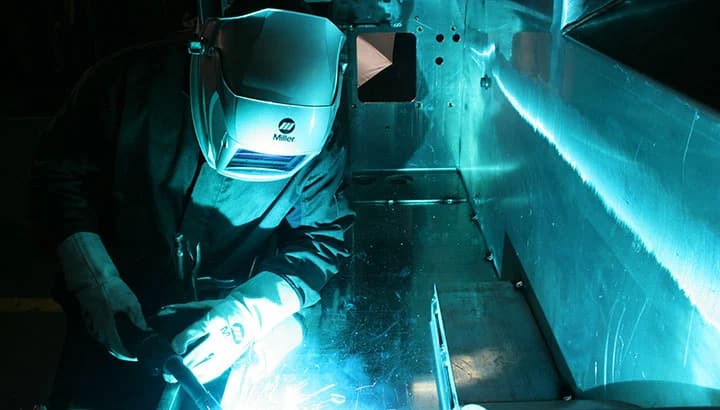
Aluminum doesn't have to be difficult to weld. Learn best practices for MIG and TIG welding aluminum in industrial fabrication and manufacturing.
Learn how modern handheld laser welding systems overcome aluminum reflectivity and heat challenges for consistent welds.