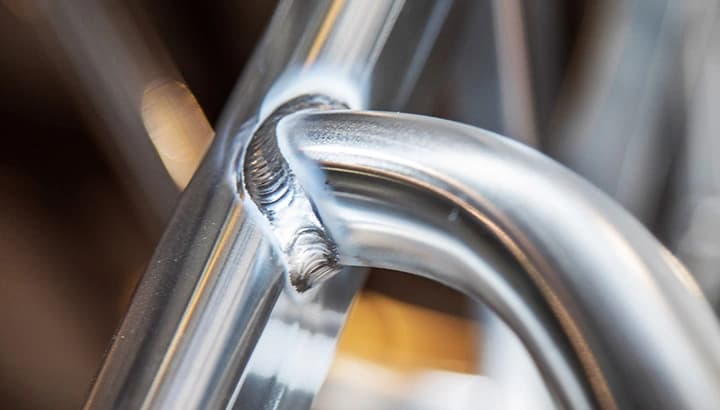
Article
Advanced Aluminum Welding Techniques: MIG and TIG Tips and Complex Answers
Get advanced aluminum welding tips in this Q&A. Move past the basics and tackle the challenges of welding aluminum in industrial applications.

Kodi Welch
Market Segment Manager, Miller Electric Mfg. LLC
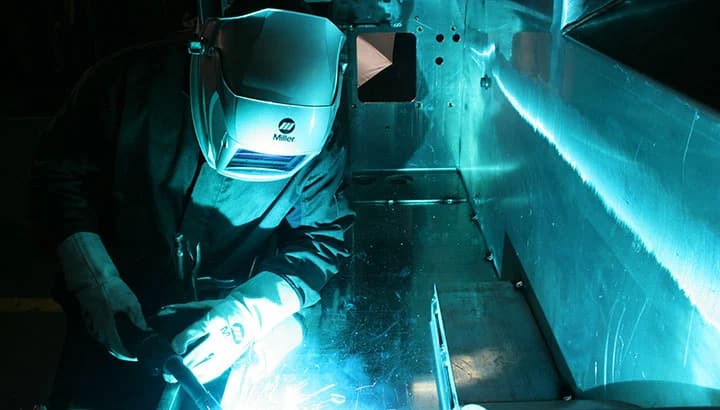
Aluminum often gets a bad rap as being difficult to weld. But it doesn’t have to be that way. To optimize results, you simply need to understand how aluminum is different from other materials. Knowing the best practices for welding aluminum can save time and money — and help ensure operators achieve quality welds.
Whether you’re MIG or TIG welding, many fundamentals remain the same when it comes to aluminum. Proper cleaning and storage, controlling heat input and reducing spatter all contribute to optimal results.
The thickness of aluminum in industrial welding applications typically ranges from 1/8 inch to 16 gauge, but you may be welding up to 3/8 or 1/2 inch in some cases. Gas and filler metal selection, as well as proper technique, may differ depending on the material thickness and the goals of the application.
The root cause of any problems you may experience in welding aluminum can also vary depending on the thickness of the material and other factors.
The tough oxide layer on aluminum can lead to issues like porosity, lack of fusion or inclusions in the weld. It’s important to properly clean aluminum base metal to remove the oxide layer and prevent possible weld contamination.
Follow these best practices for cleaning and storing aluminum base metal and filler metals:
Dirty aluminum starts you off on the wrong foot before you even strike an arc, so be sure to follow the necessary steps for cleaning and material preparation.
Selecting the right equipment for aluminum welding and fabrication makes a difference in productivity and quality. Welding power sources designed specifically for aluminum can help deliver a tailored arc, reduced spatter and bead profile control.
A system that has capabilities for pulsed MIG welding delivers advantages for aluminum by helping reduce rework and scrap as well as the time spent on non-value-added activities like weld preparation and post-weld cleanup. Reducing or eliminating those issues increases productivity, improves weld quality and reduces costs. Pulsed MIG welding can be especially beneficial on thin-gauge aluminum.
Wire feeding systems
A system that has capabilities for pulsed MIG welding delivers advantages for aluminum by helping reduce rework and scrap as well as the time spent on non-value-added activities like weld preparation and post-weld cleanup. Reducing or eliminating those issues increases productivity, improves weld quality and reduces costs. Pulsed MIG welding can be especially beneficial on thin-gauge aluminum.
In MIG welding, there are several ways to feed aluminum wire:
Push only: Feeding aluminum wire through a push only system can be difficult, but it can be done on a limited basis. It requires U-groove drive rolls to provide more surface contact with the wire, a Teflon liner, adequate drive-roll pressure and the ability to keep the gun cable straight.
Spool gun: A spool gun eliminates the possibility of bird-nesting by putting a spool on the gun so the wire only feeds a few inches. Spool guns can accommodate aluminum wire diameters from .023 to 1/16 inch and allow you to use longer cables of 15 to 30 feet.
Push-pull gun: With a push-pull gun, a motor in the gun pulls the wire through the liner, while the motor in the welder or feeder control becomes an assist motor. By maintaining consistent tension on the wire, the push-pull system helps eliminate bird-nesting. It’s also more ergonomic than the spool gun since the weight of the spool is not in the operator's hands.
For TIG welding, inverter-based, AC-capable welding power sources provide several benefits that can reduce material prep time. They also can minimize issues associated with rework and distortion from over welding and poor weld placement. Here are some basics about the two types of TIG welding power sources:
Legacy transformer power sources: A TIG welder with 60 hertz and AC output can make it more difficult to make small welds on thin material without over welding and excess distortion. Due to the slow transitions in the AC waveform, continuous high frequency is needed to maintain the arc, and AC waveforms are often characterized by a wandering arc. High primary power draw can cause tripped breakers when utilizing these power sources at higher amperages or duty cycles.
Advanced inverter power sources: With the ability to tailor almost every aspect of the arc, the welder can often reduce the extent of the material prep (beveling) while still achieving a more appropriate weld placement. These power sources also offer the ability to reduce primary power draw by over 50%. They can also reduce operator training time and increase travel speeds by 10% to 20%.
The best shielding gas for aluminum fabrication depends on the thickness of the base metal and the problems experienced during welding. If you’re experiencing porosity, for example, you may want to use an argon/helium blend gas rather than 100% argon.
Learn more about common gases used with aluminum:
100% argon: This is the gas most frequently used to weld aluminum. It is the least expensive and provides the best cleaning. It’s used for materials that are average to thinner thicknesses.
Helium/argon blend: This type of shielding gas is more commonly used when MIG welding materials that are greater than 1/2-inch thick or when operators are trying to reduce porosity levels.
Helium: A 100% helium shielding gas provides a higher ionization voltage, so using this gas has traditionally been a way to get more heat from legacy equipment. However, due helium's cost and the capabilities of inverter TIG products, helium is used much less frequently than before.
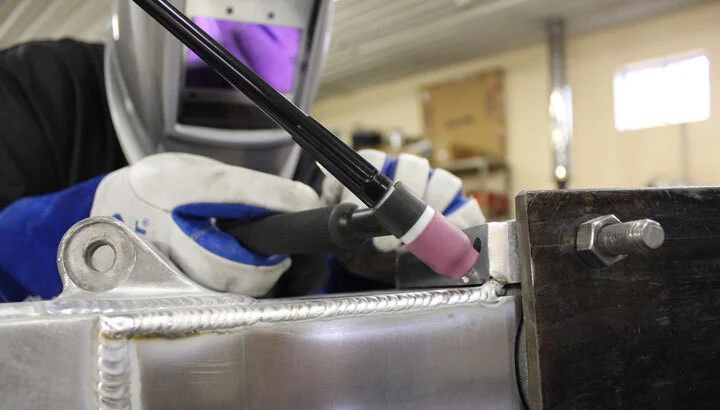
Filler metal selection also plays a role in your bead profile and a weld’s cosmetic appearance when welding aluminum.
If you’re TIG welding with a filler rod that is too small, for example, you may have trouble feeding enough filler metal into the weld puddle. Filler rod acts as a cooling agent to the puddle. Without enough of it added to the puddle, you could have problems with runaway heat and burn-through.
Filler metal for aluminum is selected based on the alloy being welded and the desired properties of the finished weld. Filler metal manufacturers offer selection charts that can help match specific aluminum alloys to the proper filler metal, based on the weld’s requirement.
The following are some common options and characteristics:
For more information about choosing filler metals for aluminum, read this article.
Controlling heat input is key for welding aluminum. If you’re MIG welding aluminum, the transfer mode being used affects the type of problems you may see and, ultimately, your success.
Short-circuit transfer should be avoided on industrial aluminum applications. Unlike when welding steel, conventional short circuit is much more problematic when welding aluminum. As the weld solidifies quickly, it leads to increased lack of penetration/fusion problems as well as increased porosity levels. This is due to the fast-freezing weld pool of aluminum compared to steel.
While thicker sections of aluminum are often welded successfully with conventional MIG spray transfer, thin-gauge aluminum offers little room for error. This is where pulsed MIG can deliver significant benefits.
Pulsed MIG is a modified spray transfer process in which the power source switches between a high peak current and a low background current between 30 to 400 times per second. During this switch, the peak current pinches off a droplet of wire and propels it to the weld joint. At the same time, the background current maintains the arc but has such a low heat input that metal transfer can’t occur. This action differs from a standard spray transfer process, which continuously transfers tiny droplets of molten metal into the weld joint. It also allows the weld puddle to freeze slightly to help prevent burn-through.
Pulsed MIG welding can also allow for faster wire feed and travel speeds while simultaneously reducing heat input and lowering the opportunity for distortion. It provides good directional control over the weld puddle and the ability to control the bead profile.
Here are six common challenges welders may encounter in industrial aluminum welding applications and some troubleshooting tips for dealing with them.
1. Lack of fusion or lack of penetration: Lack of penetration is often seen at the start of the weld, while lack of fusion typically happens at the weld toes. Issues with weld fusion and penetration can stem from the process, filler metals or parameters being used. Trying to weld aluminum using mild steel parameters can result in fusion or penetration issues. Using undersized filler metals can also cause a lack of penetration in the root, as can too little heat. Try increasing the voltage or wire feed speed to resolve fusion issues. Because aluminum conducts heat much faster than steel, it is prone to lack of fusion at the start of a weld until enough energy is put into the weld. Some welding equipment addresses this by automatically ramping up the current at the start of a weld and then decreasing it to avoid too much heat buildup. A failure to clean the oxides from the base material surface can also cause lack of fusion, since the oxide takes a lot of energy to melt.
TIG welding can often avoid the problem with lack of fusion at the beginning of welds since the weld puddle can be established prior to the filler metal being added. In the case of lack of penetration, increasing the amperage or utilizing more electrode negative amperage will put more heat into the weld zone.
2. Burn-through: On the opposite end of the spectrum, too much heat can also cause problems. Excess heat input may be caused by setting voltage or wire feed speed too high or by too slow of a travel speed. This can lead to burn-through, especially on thinner-gauge aluminum. Generally, aluminum requires a faster travel speed than steel to avoid heat buildup. Overwelding also adds more heat and can result in burn-through. When TIG welding, reduce the welding amperage or add more filler material rod (by increasing the rod diameter or pushing more length in at each addition). This has the same effect as putting an ice cube in a drink; it cools the puddle down.
3. Poor wire feedability: Wire-feeding issues are common in MIG welding. Because of its low columnar strength, feeding aluminum wire has been likened to pushing a wet noodle through a straw. Bird-nesting, or the tangling of the wire between the drive roll and the liner, is a time-consuming and costly problem. Burnback can also result when the wire stops feeding. Proper equipment setup and gun liner installation can help prevent feeding issues. Also, use the largest wire diameter practical. The pulsed welding process frequently allows one size larger wire diameter to be used at the same amperage settings as a smaller wire diameter, which helps reduce feeding problems without adding excessive heat input.
4. Inconsistent bead profile: While you can’t get a consistent bead profile if you have wire feeding issues (addressed in #3 above), proper technique also plays a role in good bead profile. It’s recommended to use a stringer bead. Whipping or back stitching slows down travel speed and increases heat input, which may result in lack of penetration or fusion. Push techniques should be used while maintaining a consistent weld puddle size and shape. The welding arc should be kept on the leading edge of the puddle, since allowing the arc to fall back into the puddle can result in problems with lack of fusion.
5. Porosity: Almost every operator at some point has dealt with porosity when welding aluminum. Porosity is most often caused by a lack of proper cleaning of the base material or using weld parameters that are too cold. Using a pulsed MIG process rather than a short-circuit process can reduce porosity on aluminum. Porosity may also be caused by a lack of shielding gas, which may be the result of improper settings on the equipment, a hole in the gun liner/torch hose or wind blowing the shielding gas away. One indicator of shielding gas problems is a very black and sooty looking weld.
6. Distortion and warpage: If you’re experiencing distortion or warpage when welding aluminum, it often comes down to heat input and technique. Lower the heat input by welding at the fastest travel speeds possible. Minimize weaving and whipping techniques, and use weld settings rather than technique to control puddle size and fluidity. Not sure what these issues look like? See examples here.
Improving results in aluminum welding
Following the best practices for choosing equipment and consumables and for welding technique can help you get better results in aluminum welding.
These tips can also help reduce overall costs in the operation. Welders who spend less time troubleshooting problems can spend more time welding. And using proper material prep and parameter settings can reduce the need for costly rework or overwelding.
Tackling the common challenges of aluminum often comes down to understanding the different properties of the material.
Following the best practices for choosing equipment and consumables and for welding technique can help you get better results in aluminum welding.
These tips can also help reduce overall costs in the operation. Welders who spend less time troubleshooting problems can spend more time welding. And using proper material prep and parameter settings can reduce the need for costly rework or overwelding.
Tackling the common challenges of aluminum often comes down to understanding the different properties of the material.
Posted Mar 12, 2026
Get advanced aluminum welding tips in this Q&A. Move past the basics and tackle the challenges of welding aluminum in industrial applications.
Aluminum doesn't have to be difficult to weld. Learn best practices for MIG and TIG welding aluminum in industrial fabrication and manufacturing.
Learn how modern handheld laser welding systems overcome aluminum reflectivity and heat challenges for consistent welds.