
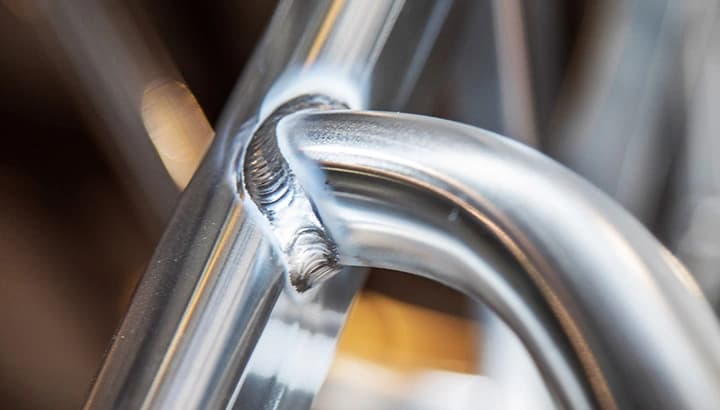
Article
Advanced Aluminum Welding Techniques: MIG and TIG Tips and Complex Answers
Get advanced aluminum welding tips in this Q&A. Move past the basics and tackle the challenges of welding aluminum in industrial applications.
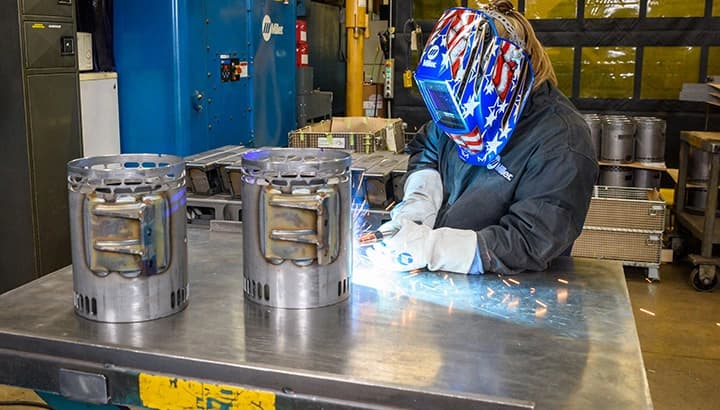
Whether used in manufacturing or by a home hobbyist, aluminum remains an in-demand material for welding applications. The main reason is that it offers high strength and corrosion resistance, even at thin gauges, making it desirable in uses where lighter weight is a requirement.
Because aluminum’s properties vary greatly from steel, working with the material presents some specific challenges. These include more sensitivity to heat input and distortion; difficulty gaining a good bead appearance; the need to more carefully clean and prep the material before welding; and the possibility for poor fusion or over-welding. Careful storage of the related aluminum welding wires is important, too, as they are susceptible to oxidation and moisture contamination. Due to their softer consistency, these wires are also more difficult to feed and usually require a specialized gun and feed system.
Despite these challenges, aluminum isn’t that difficult to weld when using the right welding system and filler metals. In fact, having a system specifically designed for welding aluminum makes attaining high-quality welds relatively easy and more efficient.
While many turn to TIG welding for aluminum, advancements in the technology and equipment for various types of MIG welding make it an excellent alternative when working with aluminum. The MIG process offers advantages such as higher deposition rates, less welding operator training and higher productivity, all while producing high-quality welds.
Manufacturers offer a variety of MIG systems for aluminum welding at different levels: for the personal user or hobbyist who makes small repairs or works with thinner aluminum, for light industrial applications, all the way to industrial and heavy industrial at the other end of the spectrum. This article will look at choosing a MIG welding system for use with aluminum in industrial applications and the benefits those systems offer.
Moving along the scale from personal user to heavy industrial, aluminum welding systems gain more amperage output, have higher duty cycles, can handle larger wire diameters and are able to manage longer welds on thicker materials. Manufacturers make power sources in the industrial and heavy industrial categories for continuous welding, day-in and day-out.
Along with considering the amperage, duty cycle and material thickness needs, another question is whether the job calls for mobility or portability. Some systems are all-in-one machines, with the power source, the wire feeder and the wire itself housed in one box. Often these are on wheels, so the welding operator is able to move them around the shop as needed. Other systems are more portable, because they have handles on the power source and the wire feeder. These features are handy for welders who carry the wire feeder to their work or bring it into tight spaces.
The transfer mode refers to the way the wire is transferred to the base material during the MIG welding process. Two common methods when MIG welding aluminum are spray transfer and pulsed spray transfer, commonly called pulsed MIG.
In spray transfer, molten droplets transfer from the electrode to the puddle. The arc is smooth and stable and produces a nice appearance with good fusion at the sides. However, since this process involves high heat, burn-through can be an issue — especially on thinner sections of aluminum. Therefore, this mode of welding requires a faster travel speed and a smaller size wire to keep the heat down.
Power sources offering pulsed MIG welding are a better choice for welding on aluminum and offer improved of out-of-position welding capabilities. A modified version of the spray transfer process, in pulsed MIG welding the power source rapidly switches between a high peak current and a low background current. During the peak current phase, a droplet is pinched off and propelled toward the weld joint. During the background current phase the arc is maintained, but has such a low current level that spray metal transfer can’t occur. The result is lower heat input and less opportunity for problems like burn-through.
Pulsed MIG welding provides good bead appearance and virtually no spatter. Also, because the weld puddle cools in between pulses, the puddle freezes faster. The puddle is less likely to sag or look excessively convex when welding out of position. And because welders can better control the heat input, they can weld thinner gauge material and use a larger diameter wire — up to 3/64 inches. This increases deposition rates and productivity, while simultaneously decreasing the chance of burn-through and the risk of distortion.
Some aluminum welding systems also offer operator-friendly synergic pulsed MIG welding that communicates between the power source, feeder and gun. With a standard system that’s not synergic, an operator may change other settings if they change the wire feed speed. But with synergic pulsed MIG, when the operator changes the wire feed speed, the machine automatically adjusts other settings. As wire speed increases or decreases, the power level increases or decreases to maintain a constant welding arc.
Manufacturers also offer a newer type of pulse technology for welding aluminum that uses the pulsed MIG process to achieve the highly aesthetic “stacked dime” appearance associated with TIG welding but with the production speeds of MIG welding. This feature generally changes either Pulse parameters or wire feed speed or both between a high and low setting. The result is a ripple pattern or stacked dime appearance. Most equipment allows the welding operator to modify the type of ripple pattern by changing the frequency.
There are three ways to feed aluminum wire:
1) push-only using a standard system
2) a spool gun or
3) a push-pull system
Feeding aluminum filler metal via a push-only system, which requires using a liner made for aluminum — typically a nylon one — can be difficult. "Bird-nesting,” or tangling of the wire between the drive roll and the liner, is a common, time-consuming problem that can result.
Spool guns and push-pull systems are much better options for feeding aluminum wires. Push-pull offers the gold standard in wire feeding.
There are different levels of spool guns. Some are made for smaller machines with lower duty cycles and others made for industrial and heavy industrial systems operating at much higher amperages. Spool guns eliminate the possibility of tangling by putting a 1-pound spool of wire right on the back of the gun, so the wire only feeds a few inches out to the arc. Spool guns can accommodate aluminum wire diameters from .023 to 1/16 inch and allow the welding operator to use longer cables.
With a push-pull system, a motor in the gun pulls the wire through the liner, while another motor on the feeder becomes an assist motor. By maintaining a constant supply of wire into the liner (while not buckling or bending it) the push-pull system eliminates bird-nesting. It also can be more ergonomic and user-friendly, since the weight of the spool is not in the welding operator’s hands.
With a push-pull system, operators need to change the wire spool (typically, 12 inches in diameter) less often. Also, operations can purchase these larger spools of wire at a greater discount and help minimize downtime for repeated changeover.
One disadvantage to push-pull systems is their relatively higher price tag. However, the increased productivity and financial advantage of buying larger spools usually provide a quick return on investment.
It’s also important to note that some industrial and heavy industrial systems offer machines made only for aluminum welding. These make the process very simple and get rid of some of the complexity, since every aspect of the system, from the gun to the feeder to the power source, internal software and welding programs, is designed to optimize welding with aluminum.
Some aluminum-only systems feature technology that ensures proper fusion at the beginning of the weld by providing higher energy when the welding operator initiates the arc called hot start. They also feature a crater function that ramps down to a cooler welding parameter to fill in the crater that can often appear at the end of the weld. Filling in the crater helps eliminate termination cracking that can occur when welding aluminum.
While there are many options and choices when it comes to welding aluminum, it’s clear that having a dedicated system helps avoid weld defects, wire feeding problems and burn-through — all issues that increase usage of wires and downtime for the welding operators.
Operations typically choose filler metal for steel by matching the tensile strengths, but strength is only one consideration when choosing aluminum filler metal. Usually several different aluminum alloy filler metals can be used with any of the aluminum alloy base metals or when welding dissimilar alloys together. In choosing a filler metal, give consideration to base metal composition, joint design, the desired strength of the weld, cracking tendencies and service requirements.
No aluminum filler metal fits all needs, however, 4043 and 5356 are the two most common and make up the majority of aluminum filler metal sales. Welding operators consider 4043 a favorite because its higher silicon content. It flows better, has a shinier appearance, gives better puddle control and provides a nice appearance, plus it’s more forgiving in terms of weld parameters. And while 5356 gets slightly lower marks for ease of welding, it offers greater tensile strength when compared to 4043. Its higher columnar strength also makes it easier to feed.
Posted Feb 14, 2022
Get advanced aluminum welding tips in this Q&A. Move past the basics and tackle the challenges of welding aluminum in industrial applications.
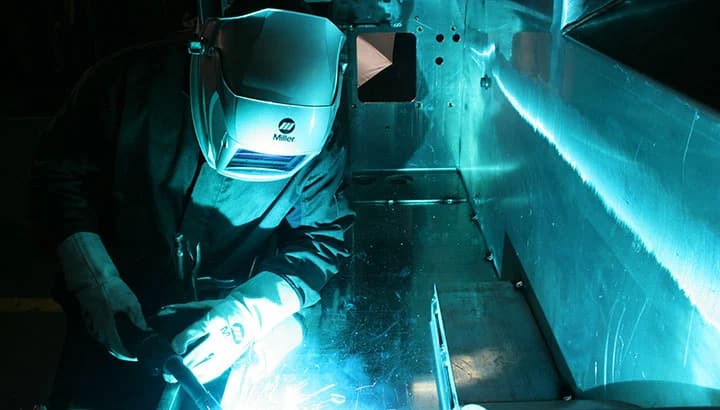
Aluminum doesn't have to be difficult to weld. Learn best practices for MIG and TIG welding aluminum in industrial fabrication and manufacturing.
Learn how modern handheld laser welding systems overcome aluminum reflectivity and heat challenges for consistent welds.