
Article
3A Sanitary Welding: What Clean, Repeatable TIG Welds Require in Food and Beverage Fabrication
Sanitary TIG welding demands precision. Learn how heat input, arc stability and prep impact clean, repeatable welds in food-grade fabrication.
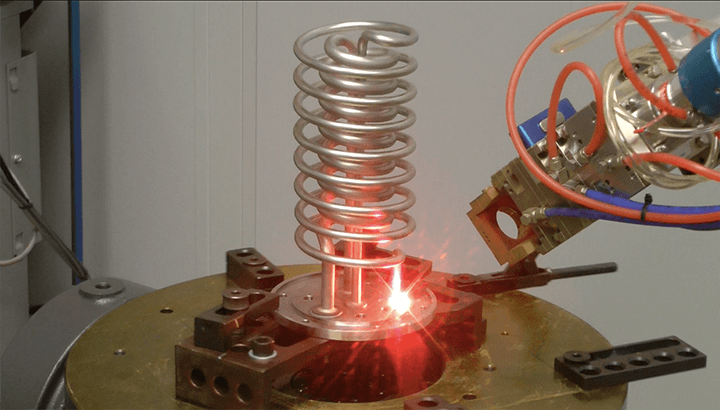
Finding ways to improve productivity and reduce costs are important factors in any welding application. Companies often look at technology advancements to achieve these goals, but many operations might not consider laser welding, which is frequently perceived as too expensive or complicated.
Today, that perception is changing. Advancements in laser welding technology, including operator-friendly solutions like the Miller® OptX™ handheld laser, have made it more accessible and affordable than ever. In many applications, especially in sheet metal, laser welding can deliver significant productivity gains and a fast return on investment.
So, is laser welding right for your sheet metal operation? Start by understanding its key factors and benefits.
Laser welding, including solutions like the OptX handheld laser welder in 1kW and 2kW models, offers measurable advantages over traditional processes like TIG, MIG and resistance spot welding:
For operations focused on sheet metal or automated production, these benefits can translate directly to improved throughput and reduced labor costs.
The use of laser welding continues to grow in automated welding applications due to advancements in technology and increased affordability.
Laser welding uses a laser to join pieces of metal. Traditionally, high-powered lasers used carbon dioxide as the medium and had a wavelength of about 10 microns. A laser of this wavelength cannot be transmitted through a fiber optic cable, making it difficult to automate a laser welding process.
Technology advancements have moved the industry forward in this regard. The evolution of 1-micron wavelength lasers means that the laser can be transmitted through fiber optic cable, making it more easily automated for welding.
In addition, 1-micron wavelength lasers are typically powered by diodes. As diode technology has improved:
These advancements make laser welding more accessible for a wider range of operations.
Parts that operations traditionally TIG weld and that require a high-quality appearance are good candidates for conversion to a laser welding process. These factors make laser welding especially well-suited for sheet metal applications.
Sheet metal is typically very thin and requires a low heat input in welding. It’s also often used in applications that require high aesthetic quality or cosmetic results, such as:
In many cases, laser welding offers several advantages, including:
For example, in electrical box manufacturing, MIG welding often requires post-weld grinding at outside corners. Switching to laser welding can remove this step entirely, saving time and labor costs.
Laser welding operates in two primary modes: conduction and keyhole, depending on energy density.
Best for:
Best for:
Operations can use the same laser welding system for both conduction mode and keyhole mode. By increasing the power or reducing the laser spot size, this changes the mode from conduction to keyhole.
Laser welding is no longer a niche or overly complex solution — it’s a practical option for many modern fabrication environments.
It’s particularly well-suited for sheet metal welding, automated production lines or applications requiring precision and aesthetics.
For operations now using MIG, TIG or resistance spot welding, a switch to laser welding can significantly improve productivity — saving time and money while still producing high-quality welds.
Posted Feb 21, 2024
Sanitary TIG welding demands precision. Learn how heat input, arc stability and prep impact clean, repeatable welds in food-grade fabrication.
Good-grade welding requires strict controls to prevent contamination. Learn five common mistakes and how to improve weld quality, consistency and durability.
Discover how low-heat welding processes help reduce sugaring, heat tint and distortion in stainless steel for cleaner, more sanitary applications.