Article
3A Sanitary Welding: What Clean, Repeatable TIG Welds Require in Food and Beverage Fabrication
Sanitary TIG welding demands precision. Learn how heat input, arc stability and prep impact clean, repeatable welds in food-grade fabrication.

Andrew Pfaller
Product Manager and Weld Engineer
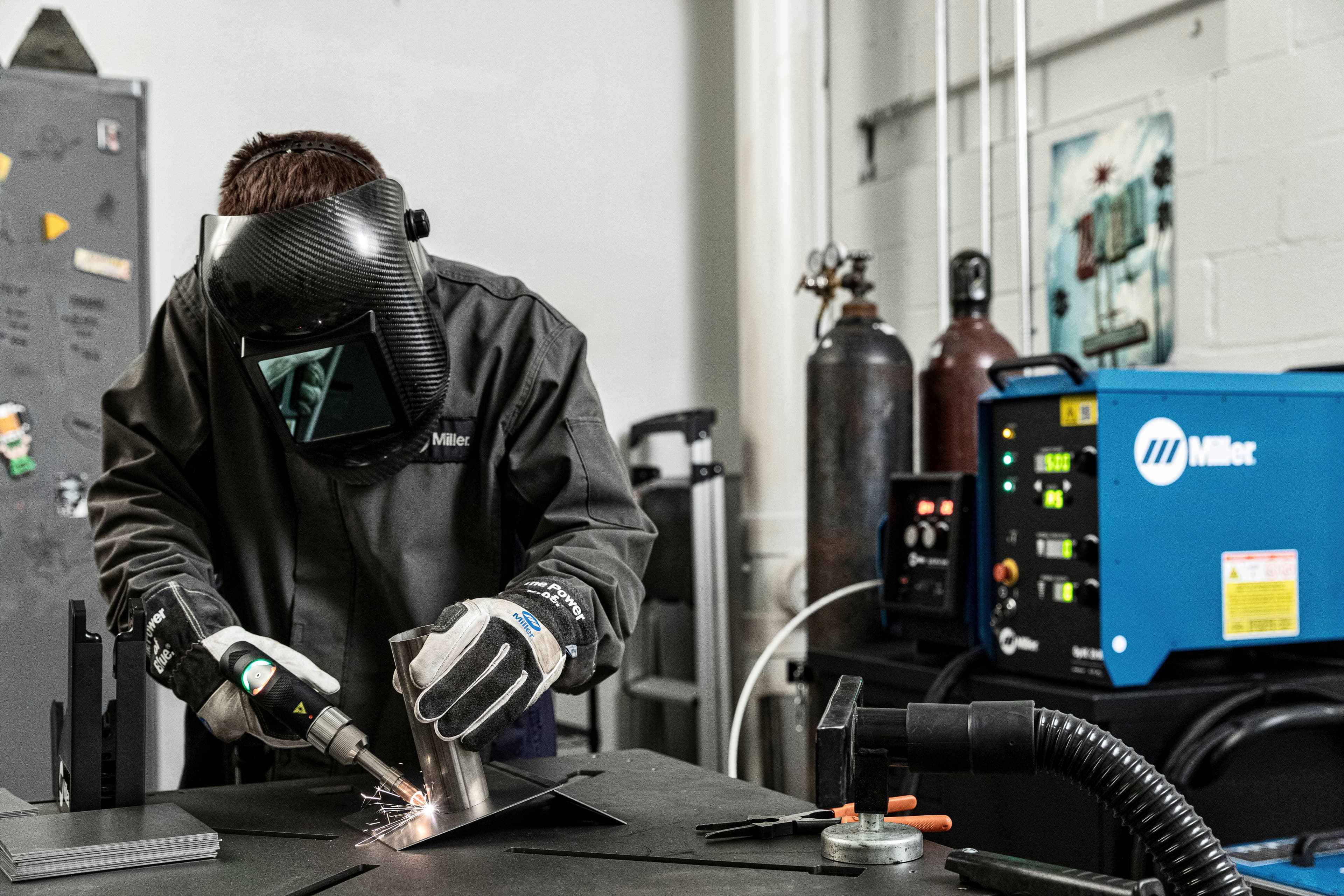
In food and beverage fabrication, a weld that is merely strong is not enough. Food‑grade stainless steel welds must also be smooth, corrosion‑resistant and free of crevices where bacteria can hide. This article explores the most common stainless steel welding defects — explaining what causes them, why they matter in sanitary applications and how they can be prevented.
Several common stainless steel welding defects can compromise these requirements, including sugaring (heavy backside oxidation), heat tint (surface discoloration), porosity (gas pockets in the weld) and distortion (warping or misalignment). These issues are typically linked to excess heat or exposure to oxygen during welding. Managing those factors is fundamental to producing stainless steel welds that meet sanitary standards while minimizing rework.
Sugaring is one of the most serious stainless weld defects in sanitary stainless steel applications and among the most challenging to resolve after it occurs. It appears as a dull gray, granular oxide crust on the backside of a weld where hot stainless steel was exposed to oxygen. During this reaction, chromium in the alloy bonds with oxygen, weakening the material’s protective passive layer. The resulting rough, porous surface can corrode over time, can trap product residue and often fails sanitation inspection criteria.
This type of oxidation most commonly develops during full‑penetration welds when the backside of the joint is not effectively shielded from air. In TIG welding, this is why internal argon purging is standard practice for tubing and pipe. Without sufficient purge coverage, molten stainless steel oxidizes aggressively once penetration is achieved. Higher heat input further increases risk by keeping the backside hot longer and widening the window for oxidation to occur.
Prevention comes down to shielding and heat control. Using a backing gas purge can provide the needed protection for full-penetration welds. Additionally, a process that tightly limits penetration and heat input helps greatly. Laser welding, for example, can fuse joints with highly controlled energy, making backside overheating far less likely. Even when full purging is impractical, fast, low‑heat welds reduce oxygen exposure time enough that heavy oxidation is uncommon. Many stainless laser welds exhibit clean or lightly colored backsides without a purge, where comparable TIG welds may show significant sugaring. Because post‑weld remediation is difficult and costly, preventing sugaring through process selection is often the most effective approach.
Heat tint on stainless steel welds is more than a cosmetic concern. The colored oxide bands adjacent to the weld bead indicate oxide thickness and chromium depletion at the surface. Light straw coloring suggests minimal oxidation, while darker blues and grays signal more severe depletion.
In food-grade service, heat tint creates two problems. Oxidized areas are less corrosion‑resistant than fully passivated stainless and are more susceptible to pitting. In addition, the roughened surface can harbor microorganisms that resist cleaning. As a result, most sanitary fabrication standards require removal of all visible heat tint, typically through acid pickling, electrochemical cleaning or mechanical polishing, all of which add labor, cost, chemical hazard and schedule time.
While some level of heat tint is unavoidable when welding stainless steel in air, its severity can be reduced. Slower welds with higher heat input — such as manual TIG welding on thin sheet — often produce wide, dark oxide bands.
Faster, lower‑heat processes generate significantly lighter tint. Laser welding combines high travel speeds with a tightly focused heat source, reducing the size and intensity of the affected zone. Stainless laser welds often display only faint straw coloration or remain nearly silver with minimal visible oxide.
In one documented manufacturing application, transitioning to a laser welding process substantially reduced post‑weld finishing time by minimizing heat tint and distortion. For any light discoloration that remains, some modern handheld laser systems, including the OptX™ 2kW with integrated cleaning functionality from Miller, offer a cleaning mode that removes oxide films and restores a bright, passivated surface without chemicals or abrasives. This capability can eliminate traditional acid baths and associated hydrogen gas exposure from the workflow.
Stainless steel welds can appear smooth externally while still containing microscopic gas pockets beneath the surface. Even small pores can trap bacteria and resist clean‑in‑place processes, making porosity a serious concern in sanitary fabrication.
Porosity is most often linked to contamination or inadequate process control, particularly related to shielding gas selection and consistency. Surface contaminants such as oil or moisture can introduce gases into the molten weld pool, while incorrect shielding gas may produce internal porosity that is not visually apparent.
Unlike arc welding, laser welding does not always exhibit obvious surface instability when gas conditions are incorrect, making disciplined process control essential. Consistently following recommended practices for joint preparation, consumables and shielding gas selection is critical to achieving dense, pore‑free welds suitable for sanitary service.
Weld distortion and surface roughness can create practical sanitary problems even though they are not metallurgical defects. Warped or buckled panels leave crevices that are difficult to clean, misaligned joints create ledges that trap debris, and scattered spatter or large convex beads require grinding before the surface can meet food-contact standards.
These issues arise primarily from excessive heat input on thin components. Stainless steel has relatively high thermal expansion, so if a large amount of heat is introduced into a seam, cooling contraction will often leave a permanent bend or twist.
By introducing roughly 50% less heat into 18-gauge stainless compared with TIG or MIG, laser welding dramatically reduces distortion. Assemblies stay flat and true, fixtures can be simpler and the finished product fits together tightly without gaps that become bacterial harborage sites.
Laser welds also produce a narrow, smooth bead profile with no spatter. There are no scattered metal droplets to chip off, no splatter-induced scratches on adjacent surfaces and no pronounced weld ripples to grind flush. The as-welded surface is often smooth enough for food contact with only a light wipe or electropolish, in contrast to the heavy grinding and repolishing that conventional welds may require.
Across all defect types, a common theme emerges: excessive heat combined with oxygen exposure. Whether using well‑purged TIG welding or high‑speed laser welding, controlling those variables leads to cleaner, more consistent results. Many fabrication shops now use a low‑heat handheld laser process alongside TIG to address thin stainless applications where heat‑related defects are most likely to occur.
Modern systems such as OptX are designed to reduce variability by guiding energy delivery automatically, allowing operators to focus on joint tracking rather than constant parameter adjustment. The result is faster onboarding, repeatable weld quality and reduced dependence on individual technique. By pairing each welding process with its ideal application, TIG for complex precision work and laser welding for thin, repetitive or long seam joints, fabricators can consistently produce stainless steel welds that are smooth, clean and well suited for food, beverage and pharmaceutical environments.
Posted Jul 7, 2026
Sanitary TIG welding demands precision. Learn how heat input, arc stability and prep impact clean, repeatable welds in food-grade fabrication.
Good-grade welding requires strict controls to prevent contamination. Learn five common mistakes and how to improve weld quality, consistency and durability.
Discover how low-heat welding processes help reduce sugaring, heat tint and distortion in stainless steel for cleaner, more sanitary applications.