
Article
8 Best Practices for Weld Fume Management
Weld shops often exceed recommended fume exposure limits. See how better fume management protects workers, productivity and regulatory compliance.
Beyond compliance, proper management of weld fume created by the welding process can help improve productivity and quality.
There are numerous ways companies can manage weld fume — from implementing a welding process change or new filler metal to the use of personal protective equipment (PPE). This article discusses some frequently asked questions regarding effective weld fume management with regard to fume extraction systems and respirators, in particular.
Please note: It is best practice to consult with an industrial hygienist for weld fume management recommendations for a given application and welding operation to help ensure the proper controls are put into place. Also remember, employee training is critical to the successful execution of these controls and other weld fume management activities.
Start with these steps:
Professional air quality testing is the most reliable method. Use the AIHA industrial hygienist directory for local contacts.
If you are concerned about potential overexposure issues in your facility, there are several key factors that affect worker exposure to welding fume to consider:
Refer to OSHA Fact Sheet 3647 for details: Controlling Hazardous Fume and Gases during Welding
Other indicators include visible haze, operators raising complaints about air conditions, and high fume-generating applications. Monitoring these helps identify overexposure situations and appropriate actions to take.
Following proper welding procedures can minimize the risk of placing more filler metal into the weld joint than necessary (overwelding), which can increase fume generation and lead to poor weld quality.
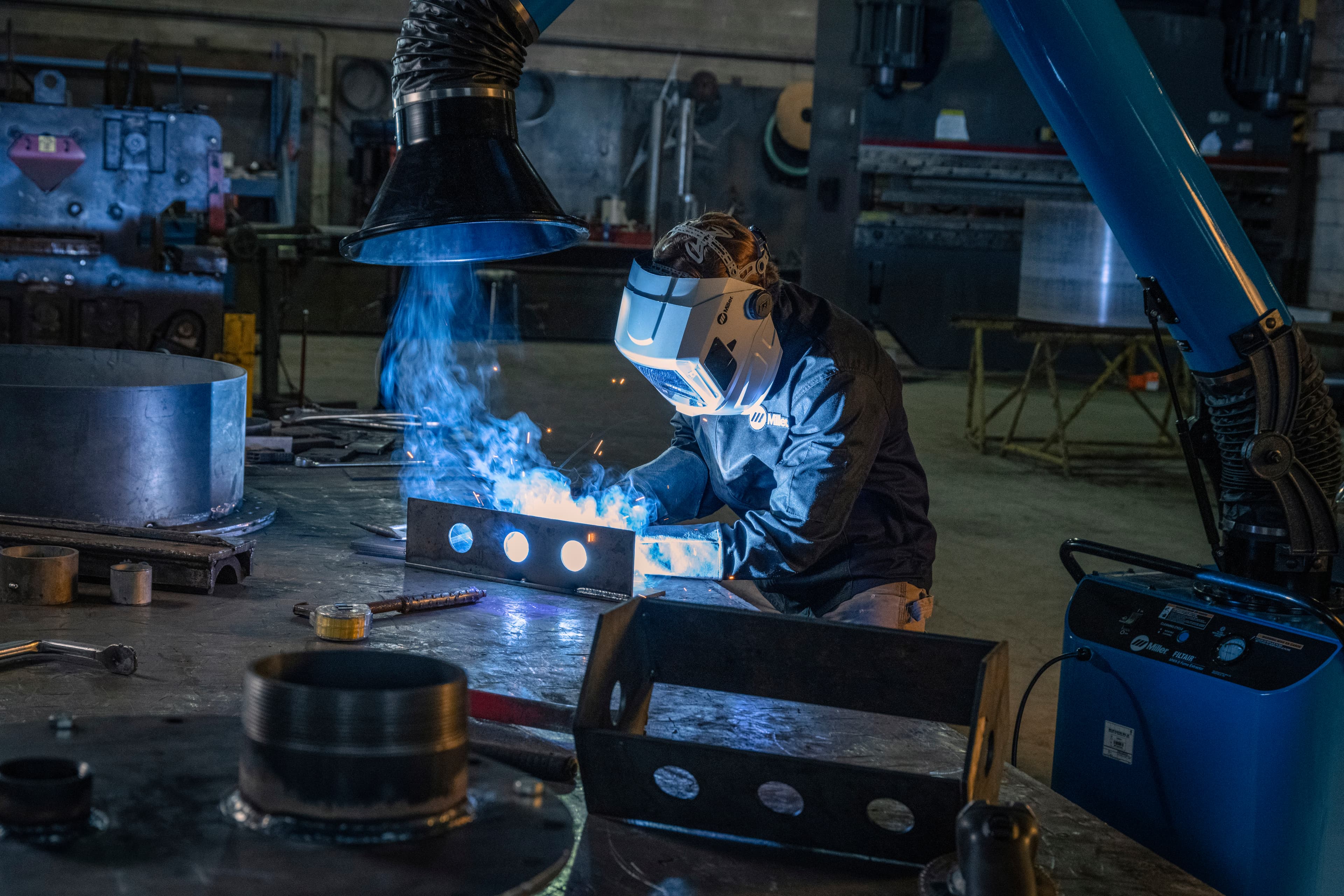
Operators should position themselves away from the weld fume. They should avoid standing between the weld and fume extraction arm, as this can prevent the extraction arm from working at full efficiency. Operators should also avoid standing in between a fan and the weld.
Limiting cross ventilation in the welding area can also help minimize interference with fume capture. Welding operators should position themselves so that airflow is moving from their back to their front. Using partitions or curtains in the welding enclosure can also help control cross ventilation.
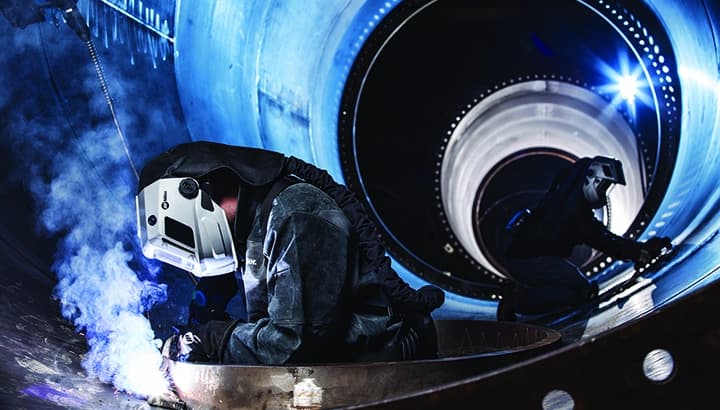
Welding in confined or hard-to-reach spaces requires extra attention to safety, visibility, and equipment. Use tools designed for tight spaces, ensure proper ventilation or respiratory protection to manage weld fumes, and follow all applicable OSHA safety requirements.
Learn more in our comprehensive guide: Solutions for Welding in Hard-to-Reach or Confined Spaces, or reference OSHA Standard 1926.1202.
To protect yourself from hexavalent chromium Cr(VI)) during welding, it is essential to implement effective safety measures. Start by considering engineering controls, such as ventilation systems, to minimize exposure to harmful fumes. If engineering controls cannot be applied in your work environment, Miller offers respiratory protection options at different Assigned Protection Factor (APF) levels, tailored to your specific welding processes.
To learn more, review Hexavalent Chromium - Overview from the Occupational Safety and Health Administration. By combining these approaches, you can significantly reduce your risk and ensure a safer working environment.
Start by deciding how close you can capture the fume, how much airflow you need, and how the equipment fits into your workspace. Portable, mobile, wall-mounted, centralized, and ambient formats allow you to match the fume extraction system to your workflow.
Ultimately, choosing the right fume extraction system depends on how you weld, where the fume needs to be captured, and how your workspace is set up.
Most systems fall into three categories: source-capture, area-capture, and ambient air-cleaning.
The airflow type determines how close the system must be to the weld and how much air it moves, which directly impacts effectiveness.
High-vacuum systems: Move a small amount of air at high pressure. Best for close-range capture using fume guns or nozzles.
High-volume systems: Move a large amount of air at lower pressure. Commonly used with extraction arms and hoods.
Ambient systems: A type of high-volume system that filters the room air.
Source capture is the preferred method of weld fume extraction because it captures and removes particulates at their source.
There are two types of source-capture systems available:
Fume extraction systems are available in different shapes and sizes and are rated based on the amount of cubic feet of air they extract per minute (cubic feet per minute, or cfm). When selecting a fume extraction system, consider the available space in the weld cell and make sure the capture velocity is sufficient to pull the fumes away from the welding operator.
Evaluating your welding process, fume intensity, and mobility needs will help you choose the most effective solution.
For more assistance, review Reduce Weld Fume Exposure by Choosing the Right Option
Low-vacuum/High-volume systems process a larger volume of air but at generally lower vacuum pressures. These systems offer larger capture zones.
High-vacuum/Low-volume systems capture weld fume much closer to the weld, via a smaller attachment such as a nozzle.
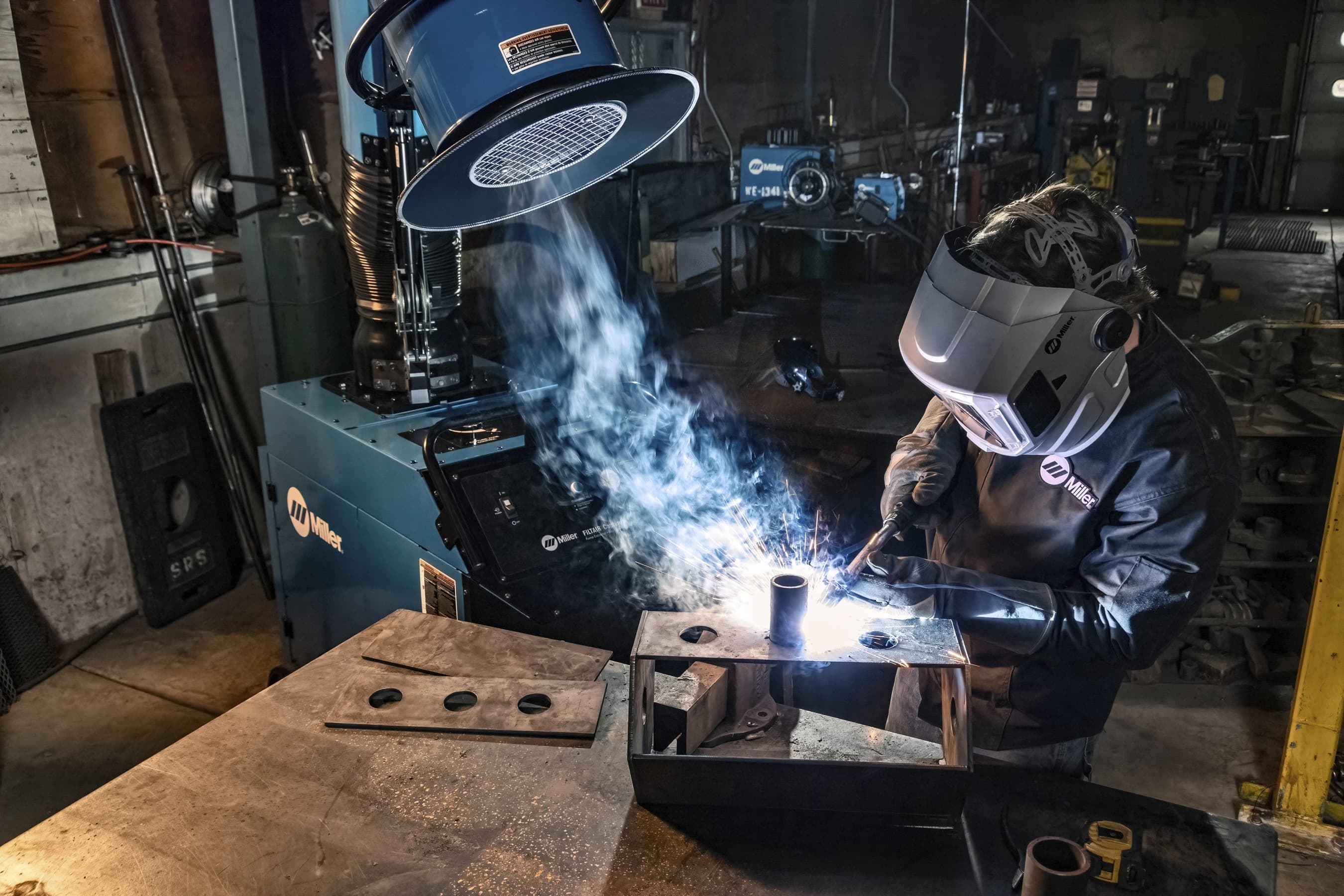
For the best results, a movable hood or fume extraction arm should be positioned above the arc, at approximately a 45-degree angle. A hood distance of 1 1/2 duct diameters is generally recommended, though the distance will vary based on the velocity and volume of air being captured. Each system varies.
Regular maintenance helps your fume extraction system run efficiently and ensures it continues to capture weld fume safely.
Proper maintenance and storage is an important part of saving time and money, and ensuring your equipment is working to its fullest capacity to help create a clean and compliant environment.
Filter replacement and maintenance is key to the efficiency and longevity of fume extraction systems. Less air passes through a dirty filter, reducing the amount of airflow at the hood for effective fume capture. Systems often have a gauge to indicate when a disposable filter should be changed. For self-cleaning systems, choosing the appropriate filter type can help optimize fume collection. Also, make sure the compressed air line is in use and working properly, and that the air is clean and dry.
According to OSHA, respiratory protection should be implemented in cases where engineering controls are not feasible, while they are being implemented, or when engineering controls alone do not reduce hazard levels below Permissible Exposure Limits (PEL).
When deciding between a Powered Air-Purifying Respirator (PAPR), half mask respirator, and supplied air respirator (SAR), consider the specific requirements and benefits of each option.
The half mask is versatile and can be comfortably worn under your preferred welding helmet, but it does require annual and daily fit checks, and users must be clean-shaven for a proper seal.
On the other hand, the PAPR eliminates the need for fit checks or clean-shaven requirements, making it a convenient option you can use wherever you are. However, PAPRs' general configuration is bulkier than that of a half-mask respirator.
It is important to note that SARs provide effective cooling and do not require a fit check or clean-shaven skin, though their portability is limited by hose length.
Respirators also vary in terms of Assigned Protection Factors (APF), where half masks provide a protection factor of 10 while PAPRs and SARs provide a protection factor of 25 or more. Analyze your work environment and needs to determine which option best meets your safety and comfort requirements.
OSHA has identified two major types of respirators: Air-purifying and atmosphere-supplying.
Air-purifying respirators have filters or cartridges and remove particulates from the air by filtering them prior to reaching the welding operator.
Atmosphere-supplying respirators provide clean air from an uncontaminated source.
Proper fitting is key with some types of respirators, such as half masks, so be mindful that fit tests may be required to ensure a proper seal.
An Assigned Protection Factor (APF) rating denotes the workplace level of respiratory protection that a respirator or class of respirators is expected to provide to employees when the employer implements a continuing, effective respiratory protection program.
Learn more about APFs for OSHA's revised respiratory protection standard.
OSHA's Small Entity Compliance Guide for the Respiratory Protection Standard helps employers determine when respirators are needed and how to select, use, and maintain them properly. The guide covers key program requirements, including hazard assessments, respirator selection, medical evaluations, fit testing, employee training, and ongoing program management to help ensure workers are protected from airborne hazards.
Read the Small Entity Compliance Guide for the Respiratory Protection Standard or review 29 CFR 1910.134(c).
OSHA requires an employer to develop and implement a Written Respiratory Protection Program with required worksite-specific procedures and elements for both mandatory and voluntary respirator use. For employees voluntarily using respirators, employers must provide those users with a copy of Appendix D to OSHA 1910.134.
Respirator inspection is an important step that can help ensure the respirator is in proper working order. Employees should be trained on proper inspection procedures before any kind of respirator is used. This information can be found in a respirator's user instructions.
Employee training should also cover topics including proper selection of respirators; the consequences of improper fit, usage or maintenance; proper maintenance and storage procedures; and how to use respirators in emergency situations.
When using a respirator, proper storage, cleaning and replacement of the units is important. The written respiratory program requires a filter change schedule. Respirator filters must be replaced, as they cannot be cleaned, unlike other fume extraction products.
Weld shops often exceed recommended fume exposure limits. See how better fume management protects workers, productivity and regulatory compliance.
Reduce welding fumes in stick and MIG operations by following OSHA's hierarchy of controls and using the proper equipment.
Prioritizing weld fume management helps companies stay compliant while creating a cleaner, more comfortable workplace that attracts and retains skilled welders.