
Article
Choosing What Filler Metal To Use for DIY Welding Projects
No matter the welding process or material, here are six questions to help determine what filler metal to use for your home welding projects.
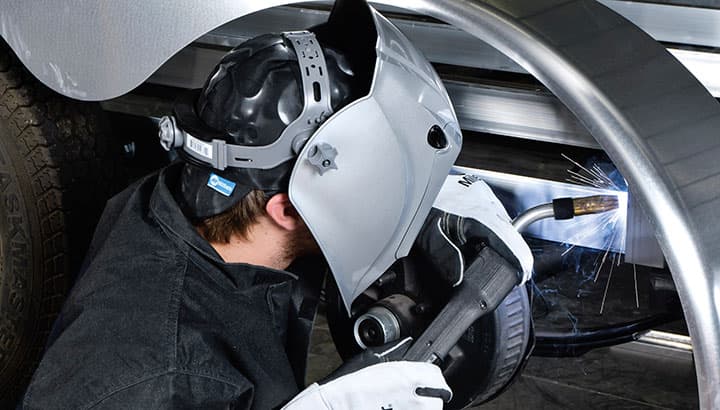
At its most basic level, welding is the joining of two or more pieces of metal using heat, forming a strong, durable bond. Whereas some processes, like bolting or riveting, simply connect materials together, welding physically combines the two pieces together at a molecular level.
The materials being joined are called the parent materials or work pieces, and heat needs to be applied to melt the metal at its connection point, also known as the weld joint. The molten metal is the weld pool, and often a filler metal is used to fill any gap between the two work pieces, which aids in strengthening the bond.
There are numerous welding techniques, each with specific applications and benefits.
Here are the main welding processes you should know about:
Arc welding
Arc welding is a general term that refers to any welding process that uses an electric arc to create heat. This heat melts the base metal at the joint between the parent materials, often with a filler material. It includes methods such as MIG (GMAW), TIG (GTAW), stick (SMAW) and flux-cored (FCAW) welding.
Submerged arc welding (SAW)
This technique uses a continuous electrode covered with a layer of flux powder that shields the weld area from contamination.
Laser welding
Laser welding uses a highly concentrated light beam to create intense heat, which allows for narrow, deep welds at high speeds. Unlike electron beam welding, laser welding doesn't require a vacuum environment. It is used in various industries, including automotive, medical and aerospace, where the precision of a welding machine laser is highly valued.
Before welding can begin, the weld joint may need to be prepped. If there’s excess rust, paint or scale, tools such as a grinder or wire brush are needed to clean the area that will be welded. If the metal is oily or has other contaminants on it, a degreaser can help remove that buildup and mitigate the risk of inclusions in the weld. Once the weld joint is ready, the right equipment will depend on the welding process.
Welding machine
This is the power source to facilitate the welding process, but it will differ depending on which type of welding needs to occur (e.g., MIG, TIG, stick).
Torch or gun
TIG welding requires a handheld torch that holds the electrode. A MIG torch (or gun) has a trigger to control the wire feed, and it delivers the wire, shielding gas and electrical current during the welding process.
Welding clamps
Clamps complete the electrical circuit and help create a stable arc.
Electrodes or filler metal
TIG welding uses different types of tungsten rods, dictated by the material type. MIG welding uses a solid welding wire for the filler metal. Selecting the right filler metal is imperative to ensure it meets the chemical and mechanical requirements of the job — and, ultimately, creates a weld that won’t fail.
Shielding gas
Used to protect the weld from contamination, the type of shielding gas used is dependent on the welding process and weld joint material. Argon, CO2 and argon/CO2 mixes are commonly used.
Flux
The key purpose of flux in welding is to protect the weld from atmospheric contamination. Electrodes or welding wires containing flux burn and produce a shielding gas, which protects the weld from oxygen and other contaminants without requiring an additional shielding gas. This ensures cleaner and stronger welds.
One of the remarkable aspects of welding is its versatility in different environments.
Welding can be performed:
It's estimated that over 50% of the U.S. gross national product is related to welding in one way or another, making it an essential process in our modern economy and infrastructure, as well as one of the most economical and efficient ways to permanently join metals.
Common applications where welders have a significant impact include:
Structural applications
Building frameworks, bridges, support systems, pressure vessels and load-bearing components.
Transportation systems
Vehicle frames, ship hulls, aircraft components, railway tracks and specialized transportation equipment.
Energy infrastructure
Pipelines, storage tanks, power plant components, wind turbines and transmission systems.
Manufacturing equipment
Production machinery, conveyor systems, industrial tools and factory infrastructure.
Consumer products
Appliances, furniture, sporting goods, electronics housings and everyday metal items.
Agricultural solutions
Farming equipment, irrigation systems, storage structures and processing machinery.
Specialized systems
Medical equipment, scientific instruments, precision devices and custom applications.
Artistic expressions
Public art, custom furniture, architectural elements and decorative metalwork.
Safety is crucial in welding, especially because sparks, spatter and bright light are everywhere on the job. This means using the right personal protective equipment (PPE) is essential to protect an operator from potential hazards and injuries.
An operator should anticipate using the following items for optimal welding safety:
Welding helmets
Eye injuries are incredibly common in welding environments, so using a properly designed welding helmet offers greater protection against them. A helmet that has a good viewing area and a lens with auto-darkening helmet technology reduces eye strain when looking at the weld joint. Additionally, advancements in lens technology, such as ClearLight™ 4x, can provide a brighter light state, twice the clarity and enhanced contrast of the weld joint for a better view of the welding arc.
Safety glasses
For maximum eye protection, safety glasses should be worn underneath a welding helmet. This added layer can protect eyes from UV radiation, infrared light and debris that could potentially make its way underneath a welding helmet. When not welding, wearing safety glasses is still important, especially in a shop where others may be welding.
Respiratory protection
Welding fumes and particulate can be harmful to an operator’s breathing, making it important to eliminate the risk as much as possible. A half mask typically covers the lower part of the face and uses a filter or cartridge system that removes particles, gases and vapors from the air. More advanced air purification systems include powered air purifying respirators (PAPRs) or supplied air respirators (SARs). These options consist of a hood, helmet or mask that’s connected to a unit that delivers clean air into the breathing zone. A PAPR is a self-contained system that filters ambient air, while a SAR delivers clean air from an air tank.
Flame-resistant gloves
The right pair of gloves will provide protection and comfort but ensure an operator still has the dexterity needed to work accurately. The ideal pair should protect against burns, cuts and electric shock.
Flame-resistant clothing
Skin should be completely covered to mitigate the risk of burns to exposed skin. Flame-resistant clothing such as pants, long-sleeve shirts and jackets or aprons made from leather protect from any direct contact with rogue sparks or hot metal.
Proper footwear
Steel-toed boots are best for welding because they are designed to support and protect the feet from the physical demands of the job.
Of course, no operation is complete without additional safety tools such as a fire extinguisher, fire-resistant blankets and a first aid kit.
Welding is equal parts technical discipline and creative intuition, and it’s a process that touches nearly everything we use in our daily life. Constantly evolving to be on the cutting edge of technology and efficiency, welding offers a diverse array of professional (and personal) opportunities.
To learn more about becoming a welder, visit aws.org.
Posted Sep 8, 2024
No matter the welding process or material, here are six questions to help determine what filler metal to use for your home welding projects.
Learn about duty cycle in welding, its importance, and how it impacts your workflow. Ensure optimal performance and safety with the right duty cycle.
Regular welder maintenance will keep your machine performing in top shape. Follow these guidelines for common welder maintenance tips.