
Article
Common Food Grade Welding Mistakes and How to Avoid Them
Good-grade welding requires strict controls to prevent contamination. Learn five common mistakes and how to improve weld quality, consistency and durability.

Andrew Pfaller
Product Manager and Weld Engineer
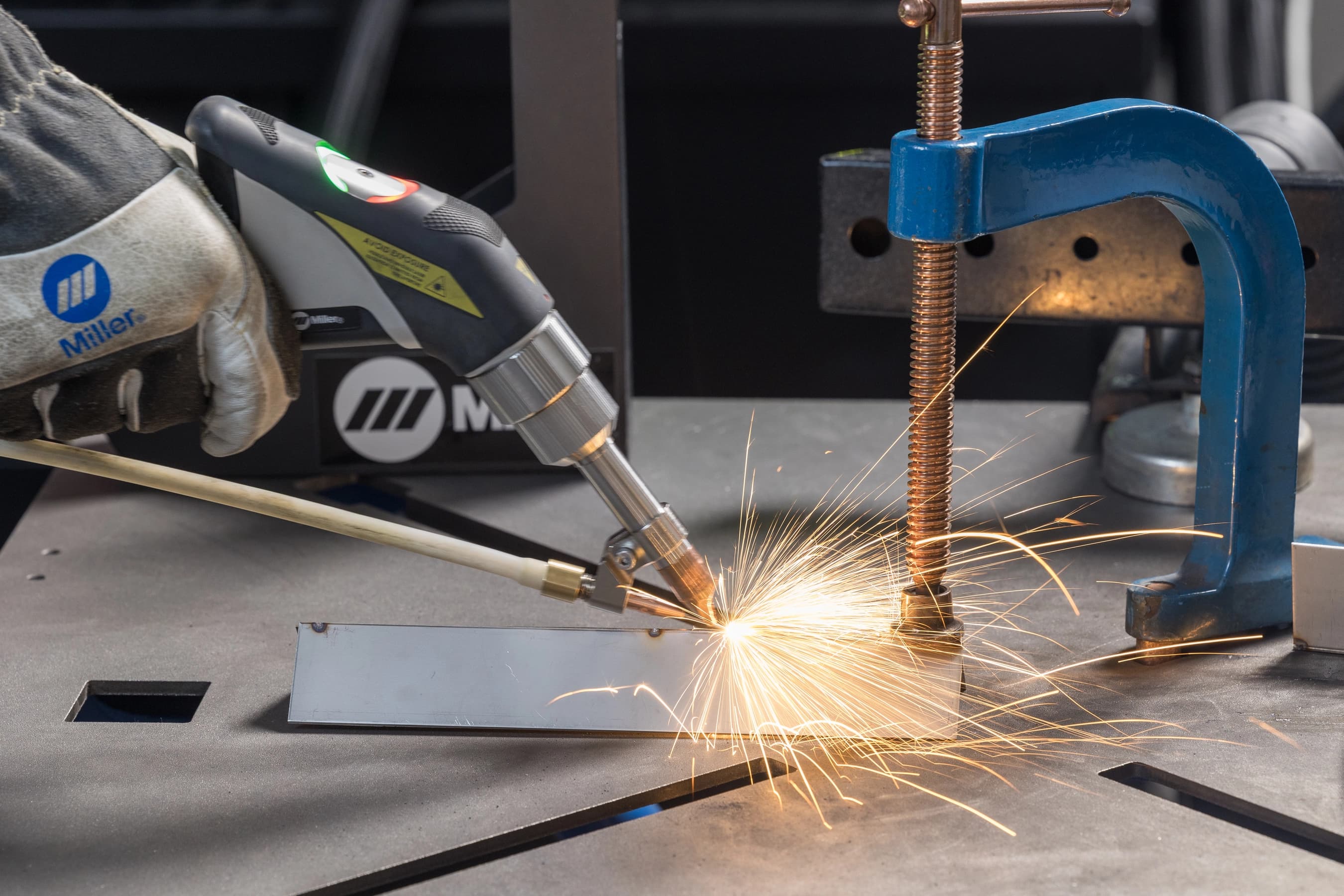
Laser welding is showing up in more fabrication shops and more conversations between welders, but it’s still widely misunderstood. For many experienced pros, it sits in an odd space. It is clearly powerful and clearly different, yet it's not always obvious where it fits on the shop floor.
Understanding laser welding starts with separating what it is from what it is not and knowing when the process makes sense for real-world fabrication.
At a high level, laser welding uses highly focused light energy to create a weld. That light is concentrated into a very small area, delivering far more energy density than most traditional welding processes. The weld forms quickly, with a high level of consistency and control.
Many welders describe laser welding as holding automation in your hand. The process manages most of the variables, and the operator steers the weld along the joint. That shift is what makes laser welding both appealing and unfamiliar at first.
Handheld systems, such as OptX™ handheld laser welders, are designed to bring this type of process into fabrication environments without requiring a fully automated cell. The intent is not to replace skill, but to apply it in a different way.
Traditional welding relies on electrical current to create an arc. Laser welding takes a different approach. Light energy is generated, delivered through fiber optics and focused through a series of lenses into a small spot at the joint.
A useful comparison is a magnifying glass in sunlight. When light is focused tightly enough, it generates intense heat. In laser welding, that heat melts the base material, and when filler wire is added, the joint is fused together.
Because the energy is so concentrated, the weld pool stays small and controlled. Travel speeds increase, and surrounding materials have less time to absorb heat. In handheld laser welding, the nozzle is typically rested on the workpiece to satisfy the safety system, giving operators a familiar feel similar to a plasma torch’s drag tip, though instead of removing material, the weld metal is fused.
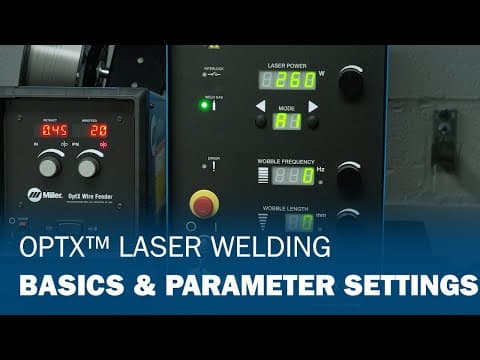
OptX™ Laser Welding Basics & Parameter Settings
One of the most important differences welders notice with laser welding is low heat input, and it helps to understand what that means in practical terms.
Laser welding does not eliminate heat. Instead, it delivers heat very quickly. The weld puddle forms and solidifies before heat can spread far into the surrounding material. That faster thermal cycle changes what happens after the weld is complete.
Parts are less likely to warp. Stainless steel shows less bluing and discoloration. Aluminum is less prone to distortion. In many shops, the biggest efficiency gain does not come from welding faster, but from having far less grinding, polishing or rework. On thin material especially, this difference can be significant.
Laser welding performs best in applications where consistency and control matter more than heavy filler deposition. Joints with good fit-up, clean material and predictable geometry tend to benefit the most.
Fillet welds, straight runs, and thin-to-thick joints are common examples. In thin-to-thick scenarios, laser welding allows heat to be localized precisely at the joint, melting both materials without overwhelming the thinner section. This is a situation that can be challenging for many conventional processes.
For lighter fabrication work, shops often look at systems like the OptX™ 1kW handheld laser welder. The OptX 2kW handheld laser welder expands flexibility across thicker sections and a wider range of applications, while the fundamental process remains the same.
Laser welding is commonly used on steel, stainless steel and aluminum, but each material responds differently to heat and energy control. Steel is generally the most forgiving and absorbs laser energy efficiently. Stainless steel is far more sensitive to heat, which is why laser welding is often preferred — its precise, concentrated energy input minimizes distortion and discoloration compared to conventional processes. Aluminum adds complexity due to reflectivity and thermal conductivity, making clean surfaces and precise control especially important.
Because laser welding concentrates energy into a very small area, surface condition matters across all materials. Oils, oxides and residue that might burn off with traditional welding can interfere with energy absorption. When parts are properly prepared, however, laser welding becomes highly efficient, with fewer defects and less post-weld correction.
This is where laser welding streamlines the overall workflow. Reduced heat input minimizes distortion, cutting down on post-weld straightening, while less discoloration means less grinding and finishing, particularly on stainless steel. Some handheld laser systems also incorporate cleaning capabilities like the OptX 2kW handheld laser welder, making it possible to target pre- and post-weld cleaning precisely, supporting consistent results without adding extra steps.
Seasoned welders may need to unlearn old habits; the overall learning curve is much shorter than with conventional welding processes. While the heat source is different, fundamentals like joint preparation and inspection still apply.
Filler wire is commonly used because it helps regulate travel speed and produce consistent results. While some welds can be made without it, filler typically makes the process more consistent and easier for people of all levels of experience to make good welds.
No. Laser welding is another tool in the shop, not a replacement for MIG or TIG. Many fabricators use it alongside traditional processes and choose the method that best fits the application.
Letting the process run. Laser welding rewards preparation and consistency more than active puddle manipulation, which can take time for experienced welders to get used to.
Posted Jul 7, 2026
Good-grade welding requires strict controls to prevent contamination. Learn five common mistakes and how to improve weld quality, consistency and durability.
Sanitary TIG welding demands precision. Learn how heat input, arc stability and prep impact clean, repeatable welds in food-grade fabrication.
Discover how low-heat welding processes help reduce sugaring, heat tint and distortion in stainless steel for cleaner, more sanitary applications.