Article
3A Sanitary Welding: What Clean, Repeatable TIG Welds Require in Food and Beverage Fabrication
Sanitary TIG welding demands precision. Learn how heat input, arc stability and prep impact clean, repeatable welds in food-grade fabrication.

Brian Bellile
Market Segment Manager
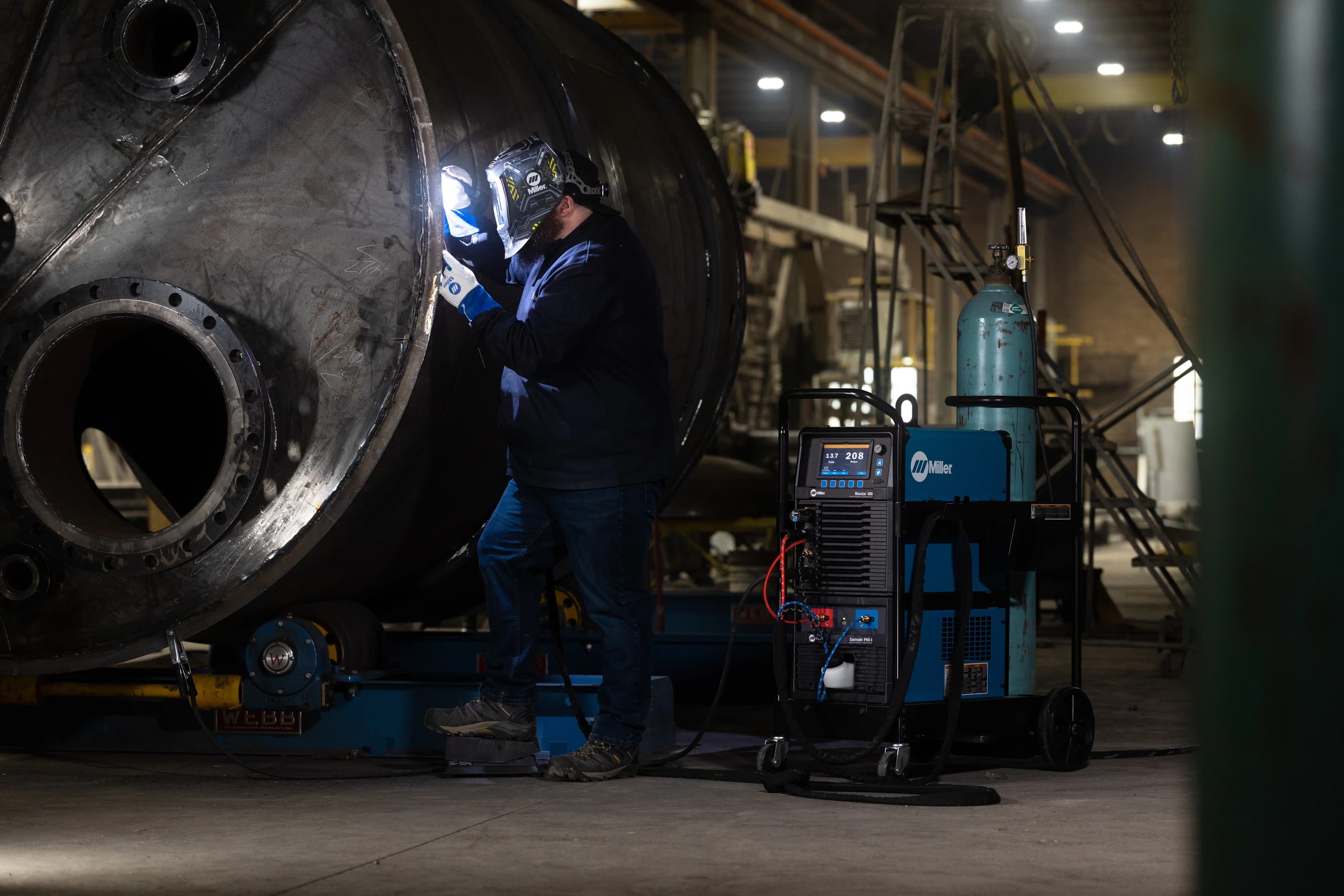
Because food and beverage equipment must meet stringent hygiene requirements, welding in these environments demands tighter control and increased rigor around quality standards than many other industries. A weld that might pass in general fabrication can become a sanitation risk in a hygienic processing environment, even if it looks acceptable at first glance. In food‑grade stainless applications, welds must do more than hold — they must resist corrosion, eliminate harborage points for bacteria and stand up to frequent cleaning and inspection. A proper food‑grade stainless weld:
When any one of these fundamentals breaks down, weld quality (and hygiene) can suffer. These are five of the most common ways food-grade welds fall short, along with tips on how to avoid them.
Excessive heat input is one of the most common and costly food‑grade welding mistakes. It often shows up during TIG welding when amperage isn’t consistently controlled, travel speed fluctuates or pulse settings aren’t optimized for thin stainless.
Why it matters: Too much heat does more than distort a part. It can actually change the properties of the stainless steel and filler metal, reducing corrosion resistance and accelerating degradation over time. Even if the weld bead looks smooth on the surface, excessive heat can compromise long‑term performance, leading to premature rusting, rework or failed inspections down the line. Heat also increases the likelihood of oversized beads, oxide formation and uneven profiles, all of which can create sanitation risks or require rework.
How to avoid it: This is where precise amperage control and arc stability become critical. TIG power sources designed for stable DC TIG performance and fine low‑amperage control, such as the Miller® Maxstar®, help welders manage heat input more effectively. The pulsed TIG function switches the amperage from a high (peak) to a low (background) at a set rate (PPS). Pulsing can reduce heat input by lowering the average amperage, increasing control of the weld puddle, penetration and distortion.
By maintaining a steady arc and allowing welders to dial in exactly what’s needed, machines like the Maxstar make it easier to preserve material integrity while producing smooth, consistent weld profiles suited for hygienic environments. Ultimately, managing heat input isn’t about welding faster or hotter; it’s about slowing down, staying consistent and using equipment that supports that level of control throughout the weld.
Inconsistent weld profiles are a visual giveaway that something isn’t right, and in food-grade welding environments, inspection often starts with what the eye can catch.
Why it matters: Uneven beads, undercut or overfill immediately draw attention during visual inspection. From there, quality teams are more likely to scrutinize the weld for deeper issues. Oversized welds also create downstream problems, requiring extra finishing and increasing the risk of contamination if profiles aren’t cleaned properly. Starts and stops can further compound the issue. Each restart can become a potential weak point or leak path if fusion isn’t fully reestablished.
How to avoid it: Consistency starts with stable arc performance and predictable amperage. Welders are far more likely to maintain uniform profiles when the arc doesn’t fluctuate and the machine responds smoothly to adjustments. Habits also matter. Making the welder comfortable — ensuring clear torch access, consistent travel speed and minimal repositioning — helps reduce starts and stops.
Many food‑grade welding failures begin before the arc is ever struck. Contamination introduced during prep is one of the most persistent — and preventable — mistakes.
Why it matters: One of the most frequent issues is improper tungsten preparation. Using shared belt sanders or general‑purpose grinders can embed foreign particles into the tungsten, leading to erratic arcs and inconsistent welds. Low‑quality or improperly handled tungsten can compound the problem, as can poor storage and handling of filler metals. In food‑grade environments, even small contaminants can create long‑term sanitation risks.
How to avoid it: The solution is using dedicated tungsten grinders (either bench‑top or portable) to help eliminate cross‑contamination. Using quality consumables, storing filler metals properly and avoiding rushed shortcuts during prep all contribute to overall better weld quality.
Maintenance and repair welds often carry higher risk than original fabrication because they’re rarely done under ideal conditions.
Why it matters: Repairs are frequently performed in active production environments, under time pressure, with limited access and done out of position. That combination increases the likelihood of skipped cleaning steps, improper heat control and inconsistent technique. The result is a higher chance of contamination, incomplete fusion or repeat failures.
How to avoid it: Predictable arc starts, low heat input and responsive amperage control are critical during repairs, especially when conditions force welders into awkward positions. Equipment that delivers consistent performance helps welders make better decisions under pressure rather than rushing to “just get it done.”
Food‑grade TIG welding demands more than a general‑purpose power source. Using the wrong equipment (or the right equipment set up incorrectly) raises the likelihood of defects from the start.
Why it matters: Features that support low‑amperage control, stable DC output and predictable arc behavior matter far more than raw power. For field repairs or maintenance work, portability and input‑power flexibility can also play a role, ensuring consistent performance even when conditions aren’t ideal.
How to avoid it: Machines designed with precision welding applications in mind help welders stay within tight process windows instead of compensating for equipment limitations.
In food and beverage facilities, welding mistakes are more than cosmetic. They can lead to contamination risks, downtime and failed inspections. By recognizing these common food‑grade welding mistakes and taking a more deliberate, controlled approach, welders can produce stainless welds that protect product integrity, support compliance and perform reliably over time.
Posted Jul 7, 2026
Sanitary TIG welding demands precision. Learn how heat input, arc stability and prep impact clean, repeatable welds in food-grade fabrication.
Good-grade welding requires strict controls to prevent contamination. Learn five common mistakes and how to improve weld quality, consistency and durability.
Discover how low-heat welding processes help reduce sugaring, heat tint and distortion in stainless steel for cleaner, more sanitary applications.