
Article
3A Sanitary Welding: What Clean, Repeatable TIG Welds Require in Food and Beverage Fabrication
Sanitary TIG welding demands precision. Learn how heat input, arc stability and prep impact clean, repeatable welds in food-grade fabrication.
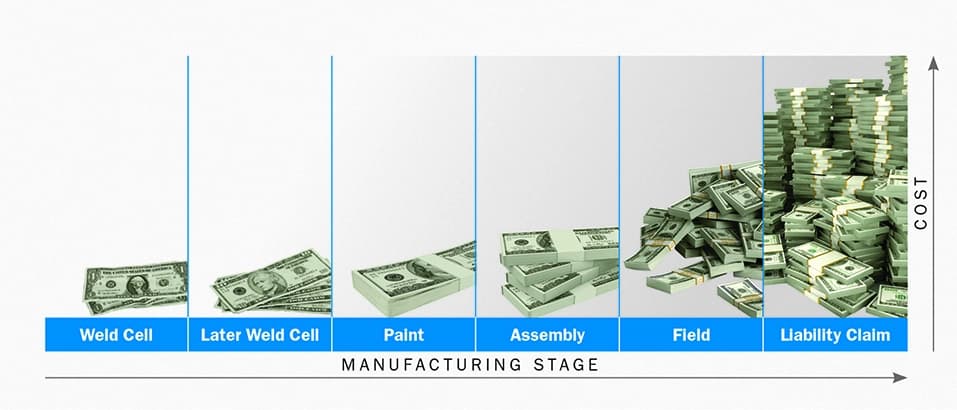
Missed or defective welds can have a negative impact on a welding operation, leading to potential safety issues and a loss of revenue associated with failures or liability claims.
Preventing missed welds and avoiding weld defects in the first place is the goal, but not always possible. If companies detect problems early, however, it can help manage costs and maintain high productivity. Welding information management systems can help.
In some cases, the consequences of a missed weld or weld failures can be far reaching. Therefore, it’s important for business leaders to understand how much opportunity there is for these problems to occur.
Some questions to consider:
If there are concerns about answers to these questions, manufacturers should consider how they can identify mistakes as soon as possible so they cost less to correct.
In a properly functioning welding operation, costs are typically broken down like this:
When a missed or defective weld goes undetected, these costs escalate at every stage in the welding operation and beyond. There are six key stages to consider the impact of a missed weld.
Stage one: weld cell
Identifying a missed or defective weld in the weld cell is ideal and smaller parts are generally simpler and less expensive to inspect and resolve than with larger components. Operators can usually add a missed weld easily — and at minimal cost. Weld failures may be slightly more difficult to address since the weld must be removed and reworked. This typically costs two to three times that of the original fabrication.
Stage two: subsequent weld cell
In operations with sub-assembly requirements, there may be additional weld cells to complete part production. Missed or defective welds found here have to be returned to the first weld cell if the operator does not have the equipment or qualifications to make adjustments.
If the part is large, the company could accumulate downtime and additional costs for moving it. For lean, “just in time” welding operations, returning a part to the weld cell could create a bottleneck while the operator is forced to wait on a part.
Stage three: paint booth
Missed or defective welds identified after painting require the paint to be removed and the part returned to the original weld cell. These redundancies result in cost for labor and rework and for the paint. For larger components requiring painting all at once, that cost could be significant.
Stage four: final product assembly
If weld failures reach this stage, the part will need to undergo three steps: disassembly, paint removal and fabrication. A dedicated employee with a mobile welding cart could resolve the problem. Another option is for a welding operator from the weld cell could make the repair. Both add to downtime and labor costs, and a mobile welding cart requires a capital investment for equipment that may only be used periodically.
Stage five: distributor or customer identification
If a distributor identifies a missed or defective weld, a company could accumulate costs to remove the product and deliver a new one. Those costs could be substantial for something like a piece of heavy equipment. Deploying a mobile welding unit or having a qualified distributor contact make repairs may be a costly option. If a customer detects a problem with the finished product, it can lead to warranty claims and require removal and replacement of the product. It may also cause a company to lose contracts and put their brand reputation at risk if missed or defective welds occur frequently.
Stage six: liability claim
Property damage or bodily injury is the most significant consequence of a missed weld or weld failure — and one that far exceeds any financial ramifications, although those still exist. Liability claims can generate significant expenses and too many could lead to future loss of business and profits. Again, these effects are always secondary to a catastrophic event, but companies must consider them as due course of operating a successful business.
Standard quality control inspections may be enough to protect against missed or defective welds — particularly in welding operations with smaller, less complex parts that can be evaluated regularly.
Larger, more complicated parts may require companies to implement redundant quality checks. For these operations, an advanced welding information management system, like Insight Centerpoint™, may be a better, more cost-effective option in the long term.
Insight Centerpoint electronically gathers weld data and offers key benefits.
This system operates using a human-machine interface (HMI) in the weld cell that guides the welding operator through the correct weld sequence and placement with visual cues on screen (usually a PC monitor). The welding operator has to complete each weld correctly and in order before proceeding to the next one.
Insight Centerpoint also monitors welding outputs to ensure parameters are correct to create a quality weld.
These include:
It can send an alert if a welding operator welds outside of an acceptable threshold or disable the welding gun until the proper person identifies the problem and offers a solution.
An advanced welding information management system can help prevent productivity loss, product quality failure and liability claims. When companies consider the upfront cost compared to ongoing missed or defective welds that could otherwise cost significantly more, the long-term benefits and savings makes good business sense.
Posted Aug 18, 2024
Sanitary TIG welding demands precision. Learn how heat input, arc stability and prep impact clean, repeatable welds in food-grade fabrication.
Good-grade welding requires strict controls to prevent contamination. Learn five common mistakes and how to improve weld quality, consistency and durability.
Discover how low-heat welding processes help reduce sugaring, heat tint and distortion in stainless steel for cleaner, more sanitary applications.