How to Reduce Welding Troubleshooting With Suitcase Wire Feeder Technology
Are you or your welders experiencing wire feeder problems? Learn how to avoid issues with the right suitcase wire feeder.
Matt Goelzer
Technical Product Specialist , Miller Electric Mfg. LLC
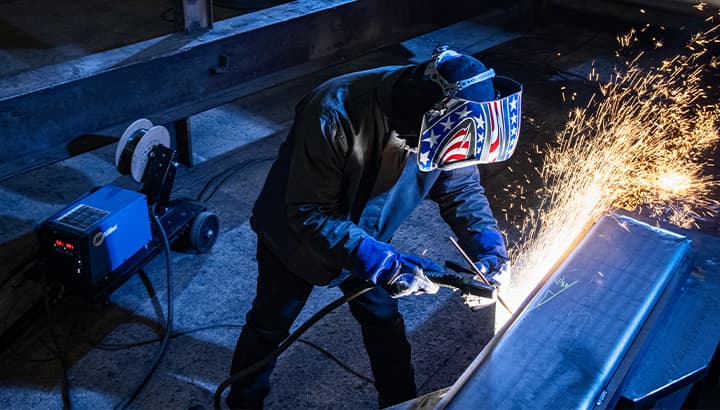
Ask any welder to name their least favorite weld-related process to perform, and it’s likely they will tell you arc gouging and more specifically, back gouging. Sometimes this process is a necessary evil to make a code-quality, dependable weld.
Carbon arc gouging, which includes back gouging and weld repair, is the fastest and most efficient way to remove unwanted materials. Although these processes are easier and more labor-efficient than conventional methods, such as using an oxy-acetylene torch or grinding, they can also come with challenges.
The process can be messy. Excess weld material that is gouged becomes molten metal that is sprayed off with compressed air and onto nearby surfaces.
The noise level is much higher. The high amperage needed to generate the correct heat makes gouging louder, and the sound is amplified even more by the compressed air.
Safety can become a concern. The arc needs to be extremely hot, so proper PPE must be worn to avoid burns and injuries.
Gouging is a time-consuming process. The operator may need to make extra trips to the power source to adjust amperage and make sure the arc is hot enough to perform the gouge or to switch to the correct polarity.
You want your welding operators’ time spent gouging to be as quick and efficient as possible so they can get back to working on the original weld. To achieve this efficiency, you must understand the power requirements for gouging. Gouging is done at high voltages, typically higher than the settings used to perform other welding procedures. If the power source doesn’t have the volt/amp curve to support the gouging process, problems will occur. For example, stick welding is most commonly used to do gouging, but that is only built for stick, not gouge performance. Often, depending on the voltage/amp curve, the equipment may deliver an amperage lower than what was preset. By using an optimized gouge setting, the machine will deliver a gouging amperage more consistent with the value that the operator set.
If all these factors don’t align, it can also affect the gouge quality. When the arc does not get as hot, the operator has the chance of “gouging cold.” This can also impact productivity, since they are not removing as much material as they could be and it takes longer to perform the gouging process. It’s crucial that the power source’s output is giving what the welder needs.
You are trying to get as much productivity as possible out of your budgets and timelines, so it’s imperative to equip welders with the most efficient tools to get the job done.
So, what sets apart an efficient gouging process? It comes down to a consistent amperage and heat output from the power source being used. Also, the ability to deliver enough power to run large-diameter gouging electrodes at high duty cycles can help cut time and save money.
By listening to welders and owners, Miller has developed a way to give your field team the most efficient gouging process with a dedicated gouge setting on the feeder that is able to maintain a gouge output needed for this process. New XMT® 650 ArcReach® Systems deliver enough power to run carbon-arc gouging electrodes at high duty cycles on jobsites.
Dedicated gouge settings on the new XMT 650 ArcReach Systems provide:
Carbon arc gouging is an important part of many welding applications — from structural steel erection to field repairs. Understanding how to choose the right equipment for the job can help improve efficiency and optimize results. Learn more about how the capabilities of XMT 650 ArcReach Systems can help you address challenges in structural steel welding and fabrication.

Are you or your welders experiencing wire feeder problems? Learn how to avoid issues with the right suitcase wire feeder.

Switching between TIG and stick polarity is made easier with new technology from Miller, which allows operators to make changes at the joint.
Follow these four maintenance tips to prepare your gas engine welder/generator for the winter months and ensure its operation at any time.