
Article
How to Choose MIG Welding Consumables to Optimize Productivity
Labor is 85 percent of a welding operation’s costs. Learn how the right consumables can improve productivity and minimize downtime.

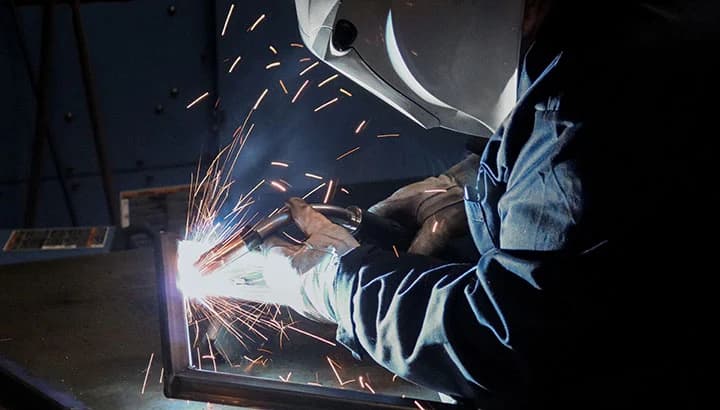
Selecting a MIG gun should be done with just as much attention to detail as the welding power source itself. Think of it as the human body: an injured toe inhibits our ability to perform basic functions such as walking. The gun is just as critical to the quality of the weld itself and the productivity of your operators. There are also important considerations when selecting a MIG gun that may help you lower your operating costs.
Let's take a look at common types of MIG guns and considerations for selecting the gun that’s right for you.
Choosing the right MIG welding gun involves more than selecting between air- or water-cooled models.
Let’s explore core MIG welding gun options and their unique features:
Air-cooled guns utilize ambient air and shielding gas to dissipate heat. Their power cables include extra copper to prevent cable insulation from melting or burning, making air-cooled guns heavier and less flexible than water-cooled models. However, they are more affordable due to their simpler design, which eliminates the need for an independent radiator cooling system and extra hoses. They are also easier to operate, assemble, maintain, and support. Air-cooled MIG guns typically range from 150 to 600 amps.
Water-cooled MIG gun systems use a radiator cooling system combined with ambient air and shielding gas to effectively dissipate heat. These systems have lighter and more flexible cables because they contain less copper. Water-cooled MIG guns are available in amperage ranges from 300 to 600 amps.
Designed to weld softer alloys like aluminum, small-diameter stainless, silicon bronze, and cored wires, push-pull guns come in both air- and water-cooled options. They are ideal for welding at distances from the power source—up to 50 feet, although 15- to 35-foot ranges are more common. Push-pull systems feature a push motor at the feeder and a pull motor on the gun, ensuring optimal wire feeding with minimal resistance. Compatibility between the feeder and gun is necessary for their operation. Available in gooseneck and pistol-style grips, these guns accommodate various application demands and operator preferences.
Spool guns enhance the feeding of soft wires by placing a small wire spool directly on a pistol-style grip. Since the wire only travels a short distance to the weld puddle, spool guns prevent issues like birdnesting often encountered in regular guns. These guns are especially useful for welding aluminum and are best suited for occasional low-amperage MIG welding tasks, such as Maintenance, Repair, and Operations (MRO). Spool guns offer flexibility and provide a cost-effective entry into MIG welding, often compatible with any 14-pin connection power source, including engine drives.
These guns capture welding fumes directly at the gun, connecting to high-vacuum fume extraction systems. Rated for up to 400 amps, these models now boast improved efficiency and user-friendly features, such as adjustable extraction controls that preserve shielding gas flow, smaller vacuum chambers for easier handling, and innovative neck designs for better joint access. These guns are especially effective when dealing with fumes from stainless and galvanized steel or high-manganese wires and steels.
While standard MIG machines can sometimes run flux-cored wires using consumable conversion packages, it’s generally recommended to invest in dedicated flux-cored guns. Flux-cored welding operates at higher temperatures and is tougher on front-end consumables.
Whether you’re welding aluminum, stainless steel, or other alloys, understanding the nuances of MIG welding guns ensures optimal performance and safety.
Whether you choose an air- or water-cooled MIG welding gun often comes down to operator preference. High-amperage pulsed MIG applications typically rely on water-cooled systems, as do applications that run larger diameter wires (1/16-in. and up). Applications with smaller diameter wires (.035-, 3/64-in.) tend to more often use air-cooled guns. Companies that run a helium mix tend to prefer water-cooled systems as helium runs hotter than other gas mixes. In general, water-cooled guns also help consumables last longer because the tip, nozzle and diffusers all run cooler. This creates less downtime and increases cost savings.
Also, are you welding in the shop or in the field? Air-cooled MIG guns are more practical for outdoor use because they require fewer parts, simplifying transport, set-up and parts management. Water-cooled systems make more sense in stationary applications because of the required water-cooling system and hoses.
As mentioned before, when welding with softer wires, push-pull and spool guns provide greater support to prevent feeding problems.
One of the most common mistakes is to buy a gun with the wrong duty cycle. Guns rated at 600 amps will more than cover almost any application you can think of. However, the added size, weight and cost of a gun with that high of a rating may exceed your needs and fatigue the operator. A gun rated at 150 or 200 amps will cost less, be lighter and easier on the operator, but won’t be suitable for extensive welding on applications that may require 300-400 amps. As new work comes in that requires MIG welding at higher amperages, you may find yourself buying a higher-amperage gun anyway.
It’s a delicate balance: you may weld at 400 amps, but a gun rated at 300 amps/100 percent duty cycle may work because you realistically will not be welding 100 percent of the time. The average “arc-on” time for a welding operator over an eight-hour day is roughly 30 minutes for each hour. Consider your welding application and determine, based on average amperage and arc on time, what MIG gun will be best.
Water-cooled systems offer a higher cost of implementation due to the added components (e.g. cooling system, hoses). This means there are more parts and components that may be prone to downtime. On the other hand, as previously stated, water-cooled systems help consumables last longer, helping reduce those associated costs.
Push-pull guns are ideal for welding soft wires and will provide greater performance and productivity than using a push-only system. However, these need to be coupled with compatible wire feeders and systems, potentially increasing the cost of implementation. If you infrequently weld with these wires, a spool gun may prove to be a wise choice because it will work with most of the welding systems you already own (provided they have a 14-pin connection) and will not require you to buy new equipment in most cases
A welding system is only as strong as its weakest part. Here are a few things to look at when specifying a MIG gun:
The back end: A heavy, sturdy power pin designed to seal the connection tightly helps prevent problems such as electrical resistance, overheating, gas leakage and poor conductivity. Look for a rigid strain relief at the connection between the power cable and the wire feeder. This will prevent kinking and improve feeding. Also, select a MIG welding gun with multiple, interchangeable plug options. A gun that can be matched with multiple feeders allows you to standardize on one type of gun and consumable. This helps to reduce equipment costs, minimize inventory and simplify the entire process.
The liner: There are three key factors when looking at liners: make sure there is a good gas seal and/or solid o-ring connection at the back of the liner to prevent gas leaks; choose liners with durable jacketing or coating to prevent additional gas loss, and select a liner designed for your diameter wire. Also, look for a liner that is easy to remove and replace to minimize downtime. Push-pull guns use unique liners designed specifically for this type gun, usually made of teflon or a type of plastic.
The power cable: that is too large can be cumbersome and cause clutter on the shop floor. A good rule of thumb is to use the smallest and shortest cable possible without limiting your welding needs. Smaller cables reduce operator fatigue, minimize clutter and help prevent excessive coiling that can lead to poor wire feeding.
Trigger options: Triggers are the only moving part on a MIG welding gun that can fail due to mechanical motion. Look for a strong, reliable trigger that is easily serviceable to help minimize downtime for component changeovers. Also, choose a gun that gives you the most appropriate trigger option for your application: standard, locking, dual pull and dual schedule switches are all available through most manufacturers. These options allow your welding operators to work with the trigger set-up that best suits them and the application. It will also further increase productivity by making welding more comfortable.
Neck and handle options: MIG welding guns are available with fixed, rotatable and flexible necks of different lengths and angles to provide flexibility when welding in various positions or tight quarters. Rotatable necks allow you to weld out-of position more comfortably without changing your gun handle or sacrificing quality. Operators can easily adjust flexible necks to fit different positions, and they save time and money for changing out and/or inventorying expensive specialty guns for a given application. Also, choose a neck with good armor (hard plastic or metal) to protect it from damage that could lead to shorts and failures in the gun. When looking at handle options, consider lightweight, comfortable styles that will meet your amperage/duty cycle rating needs. Similar to the power cable, a smaller gun handle makes it easier for you to weld. Also, a ventilated handle can reduce heat and increase your comfort and productivity.
Consumables (nozzles and tips): Less expensive consumables do not always translate into cost savings. Ultimately, you get what you pay for. By selecting a consumable based on longevity instead of price, you can reduce costs for replacement parts and for changeover time. You will likely spend more money upfront for such consumables, but more durable consumables can help reduce overall operating costs in the long run by increasing productivity and reducing downtime. It is also important to look for heavy duty tips and nozzles that provide good conductivity and gas coverage to help ensure good arc starts, less spatter and less rework and clean-up.
As you can see, the choice is much more complicated than simply picking the least expensive or most powerful gun that matches your machine. Careful consideration of your welding process, operator preferences and performance/comfort will lead you to the right MIG welding gun.
Posted Feb 20, 2026
Labor is 85 percent of a welding operation’s costs. Learn how the right consumables can improve productivity and minimize downtime.
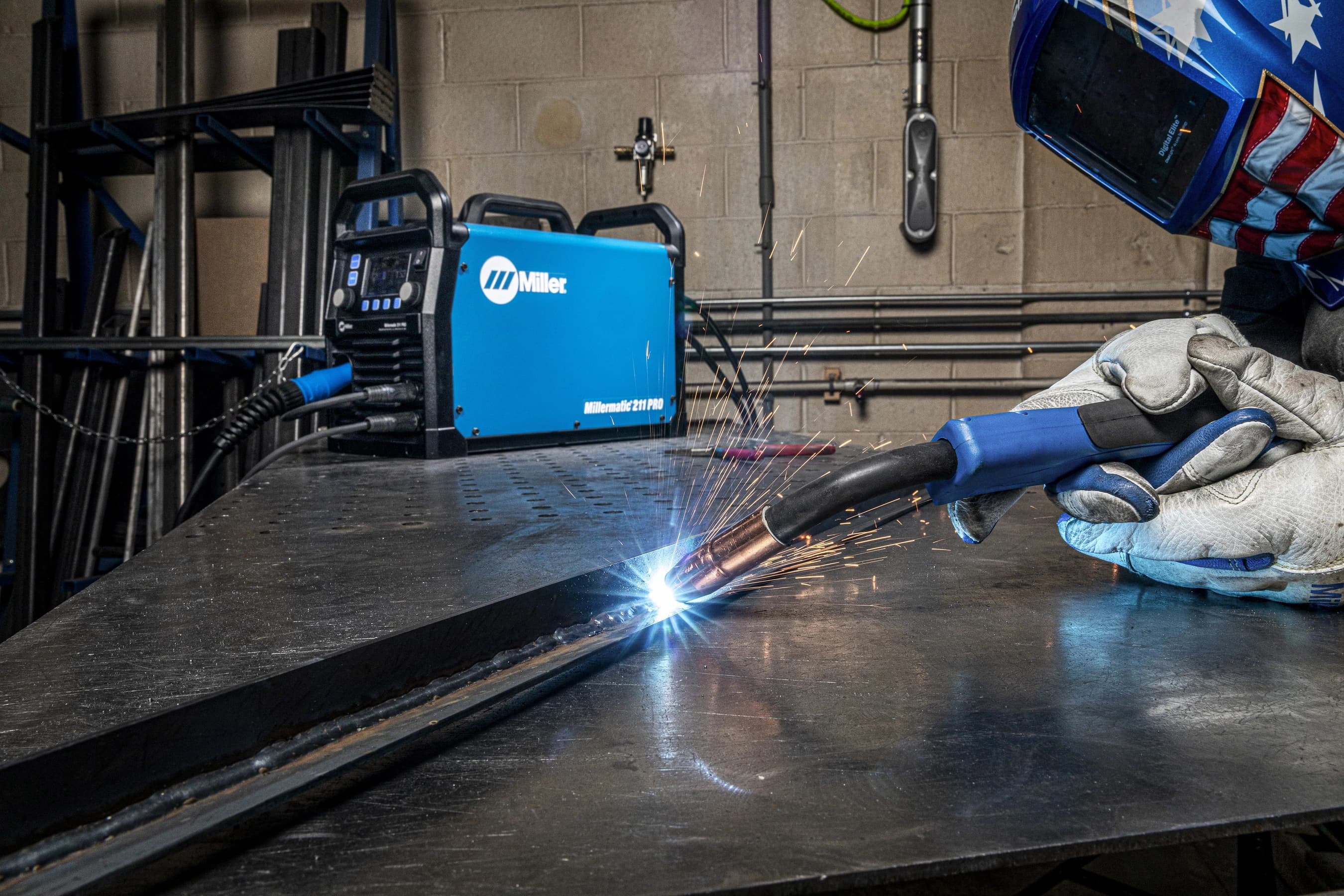
Learn MIG welding basics for beginners — how to use a MIG gun, set voltage and wire speed, choose shielding gas and get the right angle for quality welds.
Choose the right MIG gun with confidence — compare air-cooled, water-cooled, push-pull, spool and fume extraction guns plus tips on amperage and consumables.