How to Reduce Welding Troubleshooting With Suitcase Wire Feeder Technology
Are you or your welders experiencing wire feeder problems? Learn how to avoid issues with the right suitcase wire feeder.

In steel erection, completing high-quality welds with as little rework as possible is a critical part of maximizing productivity, along with keeping projects on schedule and within budget.
On structural jobsites, though welders use both fillet and groove welds, fillet welds are the most common. The strength required for the application typically determines when an operation should use a more complicated complete joint penetration weld instead of a fillet weld.
Here’s an overview of these two common types of welds on structural jobsites.
Fillet welds are the most frequently used and easiest welds to produce in structural steel field welding. They are commonly found in T-joints, lap joints and corner joints, and are used throughout a project in various configurations.
Typical applications include:
Fillet welds are often completed more quickly than groove welds, allowing welders to perform more of them in less time. These welds are generally inspected visually and rarely require additional quality assurance testing.
Concave: material curves inward to help distribute stress, which can also be more visually appealing.
Convex: a larger amount of weld metal is used to create a bulge of material, which creates a stronger weld than concave fillet welds.
Flat (or mitre): the weld is smooth with the material, which balances aesthetics and strength.
Groove welds make up a smaller percentage of welds on most projects but are critical for high-strength applications. These welds require a highly skilled welder and take more time to complete — often requiring special beveling.
These welds are typically used for:
Because of the precision and skill required, groove welds require additional testing and verification to ensure quality, especially for complete joint penetration (CJP) groove welds.
Because of their complexity, groove welds can be a source of bottlenecks on a structural jobsite. Unlike fillet welds, which can be scaled with additional labor, groove welds demand highly skilled welders, making resource allocation more challenging.
Groove welds are typically named for the shape that the base material is cut or prepared in. For example, a V-groove has angled cuts on both pieces that form a “V” shape.
Here are the most common types:
Square (or flat): No beveling, edges meet flush
V-groove: Angled cuts on both pieces form a “V” shape
U-groove: Curved cuts for deeper penetration and reduced weld metal usage.
What sets groove welds apart from fillet welds is their ability to achieve CJP, which is essential for high-strength structural connections.
Complete Joint Penetration (CJP): The weld metal reaches the full depth of the joint thickness, providing maximum strength.
Partial Joint Penetration (PJP): The weld metal does not fully penetrate the joint, making these welds less strong but still suitable for non-critical elements.
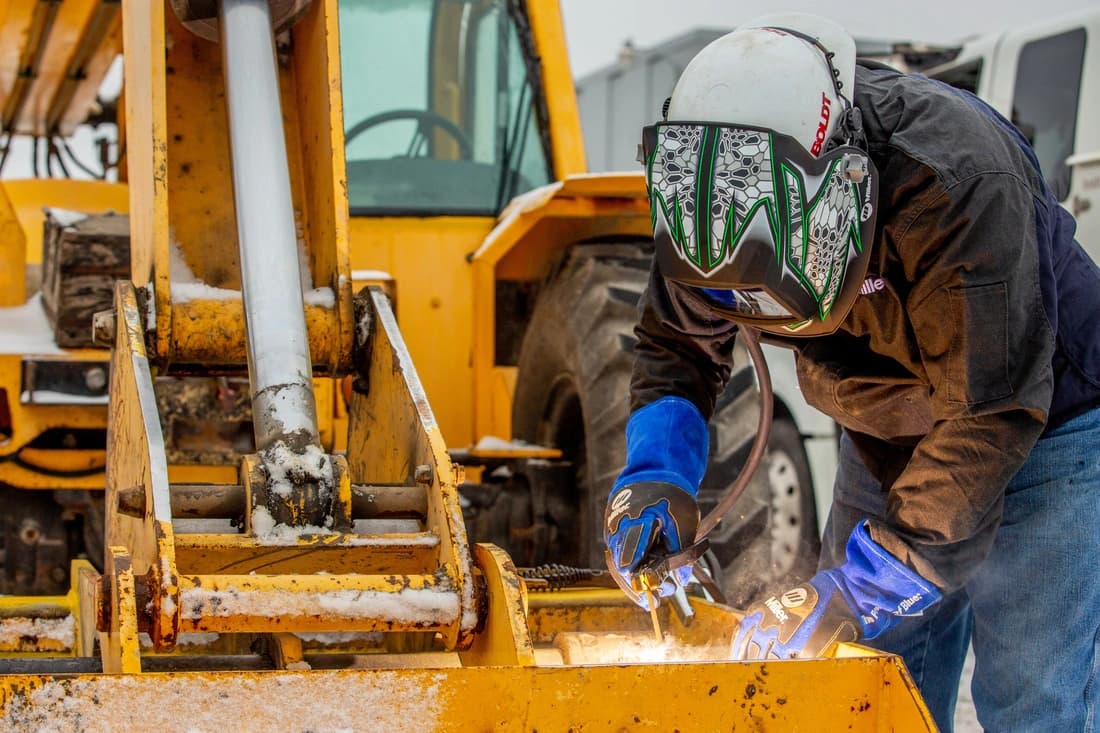
Fillet welds are common welds on structural jobsites that are easy and fast for welders to produce. They usually require no special preparation and are often inspected visually, making them efficient to complete in high volumes without slowing down production.
Groove welds are less common on structural jobsites but are critical for high‑strength applications where full or partial joint penetration is required. They take more time, demand highly skilled welders and often require joint preparation and additional testing to verify weld quality, especially for complete joint penetration welds.
Choosing the right weld type is key to jobsite efficiency, and if you’re working with stainless steel, learn how to improve your MIG welding results.

Are you or your welders experiencing wire feeder problems? Learn how to avoid issues with the right suitcase wire feeder.

Switching between TIG and stick polarity is made easier with new technology from Miller, which allows operators to make changes at the joint.

Follow these four maintenance tips to prepare your gas engine welder/generator for the winter months and ensure its operation at any time.