Article
4 Must-Dos to Winterize Your Engine-Driven Welder
Follow these four maintenance tips to prepare your gas engine welder/generator for the winter months and ensure its operation at any time.

Learn about the benefits of transitioning from stick welding to MIG and FCAW on the farm — and how to make the change.
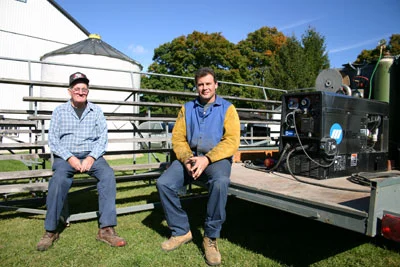
There’s an old saying that goes, “No one wants a quarter-inch drill bit, they want a quarter-inch hole.” By that same token, a farmer doesn’t want a welder, they simply want to join two pieces of metal.
For most farmers, that has meant relying on an old “buzz box” stick welder.
But just as seed, breeding and harvesting technologies have changed over that period to make farming an easier, more productive process, welding technologies have likewise improved to offer similar benefits.
Although certainly capable of meeting the demands of most farm welding applications, stick welders also have limitations. These limitations can be overcome with other welding methods, particularly wire welding, which includes Gas Metal Arc Welding (GMAW) also known as MIG (Metal Inert Gas) and flux cored arc welding (FCAW).
You can perform both MIG and FCAW with the same welder, and the processes differ only in the way they protect the weld from contamination by the surrounding air environment.
Stick welding has several limitations worth considering. Welding thin materials may be difficult or impossible — even skilled welders would hesitate before attempting to Stick weld sheet metal (18 ga. steel), and Stick is marginal for welding aluminum, requiring a lot of skill. It's also a slower process than MIG, since operators need to change rods frequently, forcing the welding operator to stop and start more often. Additionally, when the rod burns down to the stinger, it's discarded, resulting in more wasted filler metal. By comparison, the wire in wire welding (MIG and FCAW) is continuous, resulting in more efficient use of time and filler metal.
You can do both MIG and FCAW on the same welder. Like Stick welding, FCAW requires the operator to remove slag afterwards, and both FCAW and Stick are equally suited to welding on dirty or rusted material and for welding in windy conditions.
Wire welding is the easiest welding process to learn, and it handles everything from light gauge material to thick plates. It works on all common metals — carbon steel, stainless steel, and aluminum — and offers higher welding speeds, up to four times faster than Stick welding, which reduces repair and construction time. Efficiency is another major advantage: 50 lb. of MIG welding wire yields 49 lb. of metal deposition, while 50 lb. of Stick electrode rods yields only about 30 lb. of deposition. The continuous wire feed minimizes starts and stops, and the increased metal deposition — two or three times that of Stick welding — is especially beneficial for hardfacing.
One place where wire welding really shines is on aluminum.
“A lot of farming and tractor accessories are being made of aluminum to keep the weight down,” said Chris Roehl, product manager, Miller Electric Mfg. Co., “They have mammoth sprayers with big wingspan that would be awfully heavy if it were made of steel.”
Stick welding on aluminum can be difficult to perform with any degree of quality. MIG welding on aluminum is much easier and results in better looking welds.
Aluminum has special properties that deserve special consideration. Because aluminum is soft, it is difficult to feed through the gun. A kink could cause the wire to misfeed or “bird nest." One solution is a push-pull gun, which pulls the wire rather than pushing it. But for most farm or ranch uses a spool gun may be a better choice. A spool gun holds 1-lb. of aluminum in the handle, so the wire only has to feed a few inches. Cable lengths can then be up to 30-ft., allowing the operator more room to maneuver.
Stick welders can weld thicker metal, but may require multiple passes with slag chipping between passes. FCAW, too, requires slag chipping, but MIG does not. Both MIG and FCAW put down more metal in each pass, making the need for multiple passes less likely.
But it’s really on the other end of the thickness spectrum that MIG outshines stick welding. MIG welding is much more forgiving on very thin metal than stick welding, which can easily burn through metal that is 18 gauge or thinner.
“With machinery, such as a combine that has sheet metal on it,” Thompson said, “it’s a lot easier to achieve better results with MIG welder.”
Most consider wire welding the easiest process to learn.
“I tell people I can teach anyone how to MIG weld in 10 minutes—and seven of those minutes would be spent talking about the weather. It’s that easy,” Roehl said. “Everyone who has stick welded knows why the call it ‘stick’ welding. Striking and maintaining an arc take a lot of skill and practice to avoid sticking the electrode to the work.”
If a farmer needs to frequently train new farm hands, MIG saves time that could be better spent on more important tasks.
Even if wire welding is right for your farm, choosing the wrong unit will certainly result in a regrettable decision. When selecting an individual unit, it is important to pick one that is capable of handling farm applications.
Manufacturers rate welders by the amperage and duty cycle. Duty cycle is the number of minutes out of a 10-minute cycle the welder can operate before it needs to cool down.
A Millermatic 252, one of the most popular farm welders, can operate at 250 amps at a 40 percent duty cycle, which means it can weld for four minutes straight at 250 amps before it needs to cool down for six minutes. The 252 is also able to weld ½-in. steel in a single pass, which accounts for its popularity on the farm.
“Quarter-inch or thicker is very common on farms,” Roehl said. “The majority of the the farmers I talk to are purchasing the Millermatic 252 because of its versatility with aluminum and their ability to weld very thick material.”
There’s a very good reason stick welders have been found on farms the world over since their invention—they work.
Despite their drawbacks – speed, ease of use, slag, metal type and thickness limitations—Stick welders continue to meet most farmers needs, and when they don’t, there is usually a welding shop nearby to handle the tougher jobs within a couple days notice.
However, farmers in the market for a new welder, who weld on a regular basis or who frequently have welding jobs that exceed the capabilities of their Stick welders might want to give some serious thought to MIG/flux cored welding.
Wire welding can perform any task a stick welder can and many that it can’t, and they can do it more efficiently and with less clean-up.
Posted Apr 14, 2024
Follow these four maintenance tips to prepare your gas engine welder/generator for the winter months and ensure its operation at any time.
Switching between TIG and stick polarity is made easier with new technology from Miller, which allows operators to make changes at the joint.
Are you or your welders experiencing wire feeder problems? Learn how to avoid issues with the right suitcase wire feeder.