
Article
Advanced Aluminum Welding Techniques: MIG and TIG Tips and Complex Answers
Get advanced aluminum welding tips in this Q&A. Move past the basics and tackle the challenges of welding aluminum in industrial applications.
Andy Weyenberg
Aftermarket and Performance Manager, Miller Electric Mfg, LLC
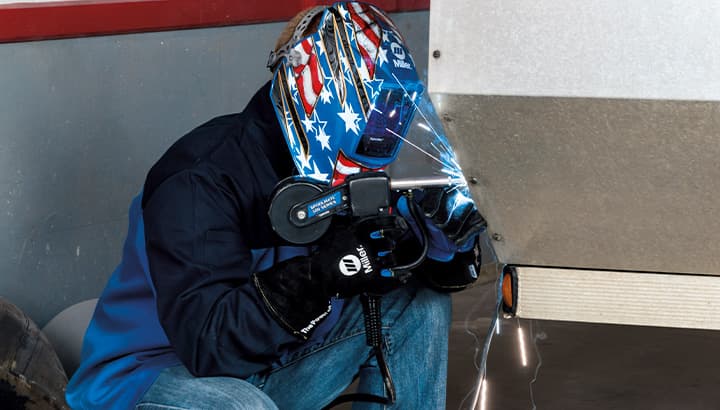
Aluminum in its pure form is a relatively soft metal that has many uses, but which requires the addition of an alloy or alloys to increase its strength and to add other qualities suitable for different applications.
Common alloys are: copper, magnesium, silicon, manganese and zinc.
They are identified by their series numbers: Wrought Series Alloy groups
Aluminum, especially thin-gauge aluminum, presents some unique welding challenges. For many, GTAW is the preferred process, but GMAW offers some obvious benefits: higher deposition rates, less operator training and higher productivity. With these benefits come a few challenges, namely wire feeding and selecting the right type of filler metal and equipment. These challenges can be easily met, however, by knowing the answers to some common questions.
While filler metal for steel is typically chosen by matching the tensile strengths, strength is only one of the considerations when choosing an aluminum filler metal. Typically, there are several different aluminum filler metals that would be acceptable to use when welding aluminum base materials. In choosing a filler metal, consider:
-Base metal composition
-Ease of welding
-Joint design
-Dilution (when the filler wire and base metal combine in the weld puddle to create a different chemical make up in the weld)
-Strength of the weld
-Hot cracking sensitivity
-Ductility
-Corrosion in service
-Color matching, if the material is anodized
-Elevated service temperature (150-350 Fahrenheit)
Different filler metals address these considerations to varying degrees. In general, if strength is the primary consideration, the filler metal should closely match the base metal in tensile, yield and ductility.
Most consumable manufacturers, as well as the American Welding Society (AWS), offer information listing the relative values of these considerations of their filler metals for each base alloy. Always make sure to use an aluminum filler metal selection chart to address the weld properties listed above.
Traditionally, welders have relied on AWS 4043 and 5356 wires, as they can be used with the most widely used aluminum alloy base metals. Hobart, however, offers an alternative to 4043 filler metals to increase strength and quality. The MaxalMig® 4943 aluminum wire offers approximately 20% higher tensile strength and doesn’t rely on diluting the aluminum base material to gain strength. This feature often allows welders to make smaller, single-pass welds and still get reliable strength. It also helps minimize the risk of distortion since heat input is lower.
Aluminum as a filler metal has the same oxidation problems as all aluminum. When left open, either on the shelf or installed on the welder, aluminum filler wire will oxidize, which can lead to an erratic arc. The oxidation adds resistance, can produce smut and can change the wire’s ability to feed smoothly. Many operators have spent a great deal of time adjusting tension settings, changing contact tips or checking the shielding gas trying to fix the problem when it was the oxidized wire that was at fault.
Because of its low columnar strength, feeding aluminum wire has been likened to pushing a wet noodle through a straw. Birdnesting, or the tangling of the wire between the drive roll and the liner, is a common, time-consuming and costly problem. Clearing it requires the operator to stop welding, cut the wire, discard the wire in the gun and re-feed new wire through the liner. It also may require cleaning or changing the contact tip because of the burnback caused when the wire stops feeding.
Push only: Feeding aluminum wire through a push-only system can be difficult, but it can be done on a limited basis. It requires u-groove drive rolls to provide more surface contact with the wire, adequate drive-roll pressure and the ability to keep the gun cable straight. Any resistance in the line will likely cause the wire to misfeed. Thicker wire, such as 1/16 inch, may be fed consistently in a push-feed system. But for thinner gauges, such as .030 inch, push feeding is not very dependable.
Spool gun: Welding aluminum with a spool gun, such as the Spoolmate™ or Spoolmatic® series of guns, eliminates the possibility of birdnesting by putting a 4-inch (1-pound) spool on the gun, so the wire only feeds a few inches. Spool guns can accommodate aluminum wire diameters from .023 to 1/16 inch and allow the operator to use longer cables (15-50 foot).
A spool gun needs to have the roll changed after every pound of wire is used, compared with the 16- or 22-pound spool on a push-pull system. In tight spaces, the spool may limit access, requiring the operator to use a longer stickout. If the operator is using several pounds of aluminum per day, the few minutes needed to change spools can add up. Also, the chance of burnback exists when the end of a spool is reached, so many operators stop when a few turns are left on the spool.
Push-pull gun: With a push-pull gun, a motor in the gun pulls the wire through the liner, while the motor in the welder or feeder control becomes an assist motor. By maintaining consistent tension on the wire, the push-pull system helps eliminate birdnesting. It is more ergonomic than the spool gun since the weight of the spool is not in the operator’s hands.
Also, the spool needs to be changed less often than on a spool gun and allows the purchase of larger spools. A push-pull gun also allows cables up to 50 feet long. The only disadvantage to push-pull systems is their relatively higher price tag, but the increased productivity and the financial advantage of buying larger spools usually provide a quick return on investment. When you compare the cost of 16 1-pound spools of .035-inch 4043 aluminum filler wire with one 16-pound spool of the same diameter wire, plus the time to change 16 spools versus one spool, you’ll see that for high-volume use, a push-pull system makes financial sense.
A welding distributor, picked at random, lists a price for a 1-pound spool of .035-inch aluminum wire as $11.46. A 16-pound roll lists for $170.24, which works out to a difference of $0.82 per pound. Now, add the time for 16 spool changes (and possibly burnbacks) for the spool gun as compared with one change for the larger spool. At five minutes to change a spool, that’s 80 minutes of extra time for each 16 pounds of filler wire used.
Continuous-feed push system: This is a relatively new addition to the field. This type of system uses a special drive system that maintains continuous contact with the wire and eliminates the possibility of birdnesting since there is no gap between the drive rolls and the liner. While it is limited to pushing the wire 15 feet, the gun is lighter than either the spool gun or the push-pull gun and requires no additional maintenance.
The short-circuit transfer mode is not recommended for aluminum. It’s almost impossible to obtain good fusion and the weld will be prone to breaking or cracking. It should certainly not be used when appearance or strength is an issue.
In spray transfer, molten droplets are smoothly transferred from the electrode to the puddle. The arc is very smooth and stable and produces a nice appearance with good fusion at the sides. Since it involves high heat, burn-through can be an issue on thin (1/8 inch or less) material, so it requires a faster travel speed and a thin-gauge (.030-inch) filler wire to keep the heat input down.
With pulsed welding, or pulsed MIG, you’re always in spray transfer mode; the wire will transfer across the arc, then drop to a lower amperage, allowing the puddle to cool while maintaining the arc. This allows for out-of-position welding, and the pulse agitates the weld puddle, aiding the cleaning action. Because the heat input can be better controlled, (on some machines, you can even shape the pulse waves) you can weld thinner-gauge material and use a larger-diameter wire (up to 3/64 inch), with a decreased chance of burn-through and increased deposition rates.
Because you can use 3/64-inch filler wire to weld thin-gauge material, you not only increase the deposition rate and aid feeding by using a stiffer wire, you can save money on filler wire. The same distributor who charges $170.24 for a 16-pound spool of .035-inch aluminum filler wire (see above), charges $200.20 for a 22-pound spool of 3/64-inch wire — a difference of $0.63 per pound. Add in the decreased time and materials for rejected parts, and pulsed MIG may look like an attractive alternative, depending on your particular application.
Pulsed MIG is simple to use and a very easy process to train operators to make quality welds with — much easier than it is to train a TIG operator. Plus, the appearance of a pulsed MIG weld can rival that of a TIG weld.
Posted Jun 26, 2025
Get advanced aluminum welding tips in this Q&A. Move past the basics and tackle the challenges of welding aluminum in industrial applications.
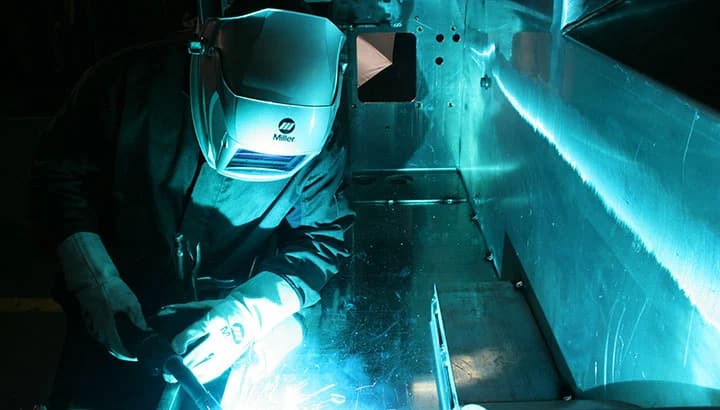
Aluminum doesn't have to be difficult to weld. Learn best practices for MIG and TIG welding aluminum in industrial fabrication and manufacturing.
Learn how modern handheld laser welding systems overcome aluminum reflectivity and heat challenges for consistent welds.