
Big Blue® 600 Pro Truck Mount Spec w/ Wireless Interface Control
Engine Driven Welder907737004
Tier 4 Final 600 A engine-driven welder for welding, gouging and power. Wireless control optional.

The quicker you get jobs done — in an efficient manner, in a safe manner — you’re going to get more jobs and bigger jobs. It’s just night and day, the difference with this (ArcReach) system.
Field superintendent, Apex Steel
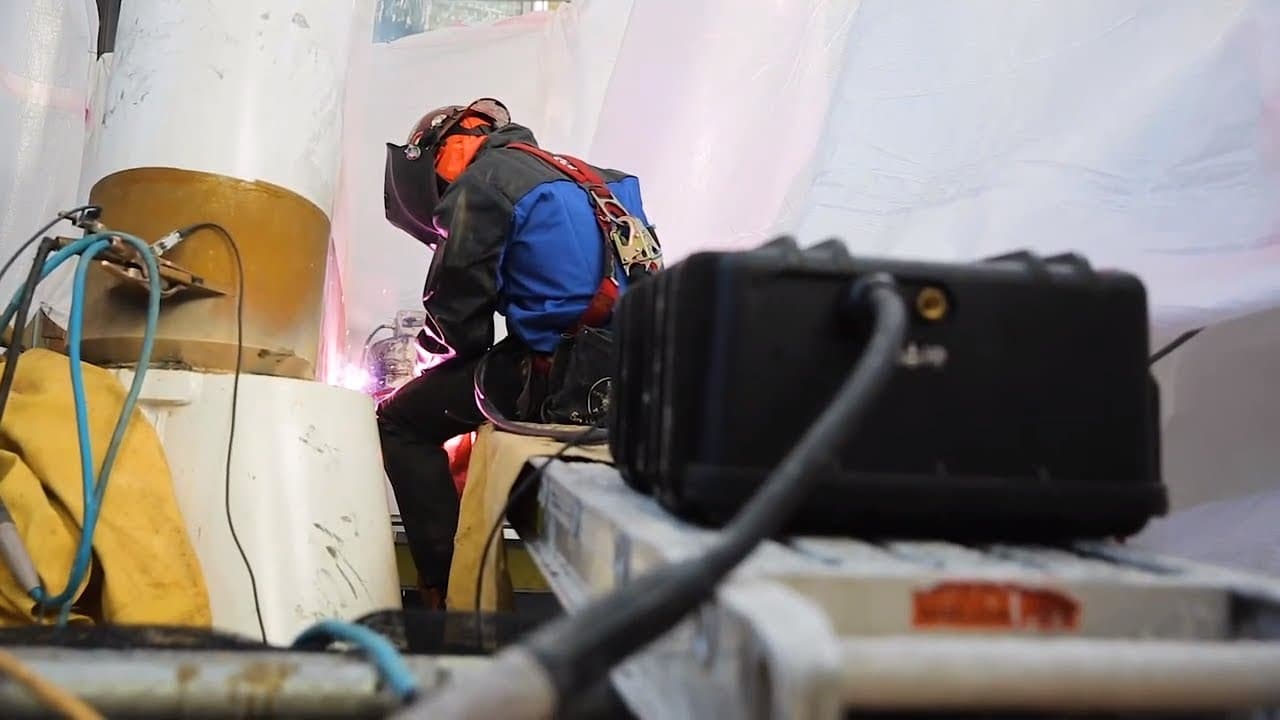
Apex Steel Saves Time with Miller ArcReach Welding Technology
Cranes and under-construction high-rises dot the Seattle-area skyline — a telltale sign of the building boom there. In such a demanding market, it’s important for contractors to complete jobs quickly, while also meeting stringent seismic structural welding code requirements.
For Apex Steel, a structural steel contractor based in Kirkland, Washington, finding ways to save time while still meeting quality demands is critical to productivity, scheduling and the bottom line. Demanding project timelines and quality requirements are key drivers for structural steel contractors like Apex. Many building projects in Seattle must meet the American Welding Society (AWS) D1.8 structural welding code — stringent requirements used in seismic regions. As a result, the area sees a higher demand for D1.8 certified welders.
Apex specializes in steel erection, architectural metals, reinforcing steel, and tower crane and construction hoist projects, working extensively in the Seattle region with another office in Billings, Montana. The company’s construction work runs the gamut from small to large projects such as high-rises and bridges.
Utilizing wire welding processes and ArcReach remote control welding technology from Miller Electric Mfg. LLC allows Apex to address numerous challenges — helping to significantly improve productivity while meeting high-quality requirements and improving operator safety on the jobsite.
“The quicker you get jobs done — in an efficient manner, in a safe manner — you’re going to get more jobs and bigger jobs,” says Travis Slovernick, Apex field superintendent. “It’s just night and day, the difference with this (ArcReach) system.”
In addition to significantly improving productivity, remote control capabilities at the weld joint also provide benefits for worker safety. The fewer trips an operator must make back and forth to the power source — often up or down ladders or several flights of stairs — the fewer opportunities there are for slips, trips and falls and exposure to other jobsite hazards.
“We get in spots where it can be hard to get to sometimes, and when you do get there, the last thing you want to do is move again just to go up a volt or drop your amps,” says Kyle DePaoli, an ironworker from Local 86. “Not having to get off the iron every two minutes saves a lot of time, and it’s safer.”
It can also be an issue of operator fatigue, when an operator must climb up and down stairs frequently or get to and from a hard-to-reach welding location. One Apex job in Bellevue, Washington, involved constructing a sky bridge pedestrian walkway between two buildings. Operators used ladders laid flat to reach the weld, where they were joining two columns about 20 feet off the ground. Getting to the ground required maneuvering from that spot and going down several flights of stairs.
“The wear and tear on the guys and the fatigue — the remote technology saves everybody all the way around,” Slovernick says.
Not having to get off the iron every two minutes saves a lot of time.
Ironworker, Local 86
The ability to adjust parameters at the weld also eliminates operators to “making do” with less-than-optimal settings.
“Otherwise you might just say ‘that’s good enough,’” DePaoli says. “This way you’ll probably have your parameters where they should be.”
This helps ensure that Apex is meeting D1.8 structural welding code requirements and producing high-quality welds.
In addition, pairing an ArcReach wire feeder with an ArcReach power source locks out any changes to the weld process, voltage or amperage at the power source — only the welding operator can make changes at the feeder. This prevents accidental changes and eliminates mistakes that can occur if parameters are incorrectly changed.
“You’re sure that nobody can mess with your settings,” DePaoli says.
For the sky bridge project, Apex needed a self-shielded flux-cored wire certified for D1.8 structural welding code and Charpy V-notch testing at -20 degrees Fahrenheit. Pacific Welding Supply put Apex in touch with Hobart, and Hobart evaluated and certified its Fabshield® XLR-8 self-shielded flux-cored wire for those requirements — saving Apex time and money.
“Hobart ran a special test for us and worked with us side by side,” Slovernick says. “It’s a wonderful wire to work with.”
It has become the company’s “go-to” wire. Apex uses the wire on many projects because it has a wide operating window, making it user-friendly and dependable in consistently producing quality welds. It’s suited for high-strength applications and offers low hydrogen levels, and because it’s self-shielded it doesn’t require a shielding gas.
The wire also helps Apex improve productivity by reducing the time spent on clean-up between weld passes and post-weld, since the slag releases easily.
“It’s a forgiving wire — even when you’ve got a rough surface instead of a nice smooth iron,” Perkins says. “With your settings right, the slag will just fall right off. You just slide a brush across it, and it’s ready for the next pass.”
Apex works to ensure the company utilizes the most productive and efficient solutions on the jobsite — for the greatest impact on productivity and safety. ArcReach technology helps Apex save time and money while maintaining high quality, so the company can complete projects quickly and move on to the next job.
“Anything that can help productivity-wise, efficiency-wise — that’s key for us,” Slovernick says.
Posted Feb 5, 2024
Tier 4 Final 600 A engine-driven welder for welding, gouging and power. Wireless control optional.

ArcReach 16 portable wire feeder. Instant weld-to-gouge. Supports 60 lb spools, 3/32 in wire.

Designed with the professional in mind. The best for ease of use, reliability and fuel economy.