Guide to TIG Welding Basics
TIG welding, also known as gas tungsten arc welding (GTAW) is a precision welding process known for producing clean, high-quality welds.

Mike Drummond
Product Manager
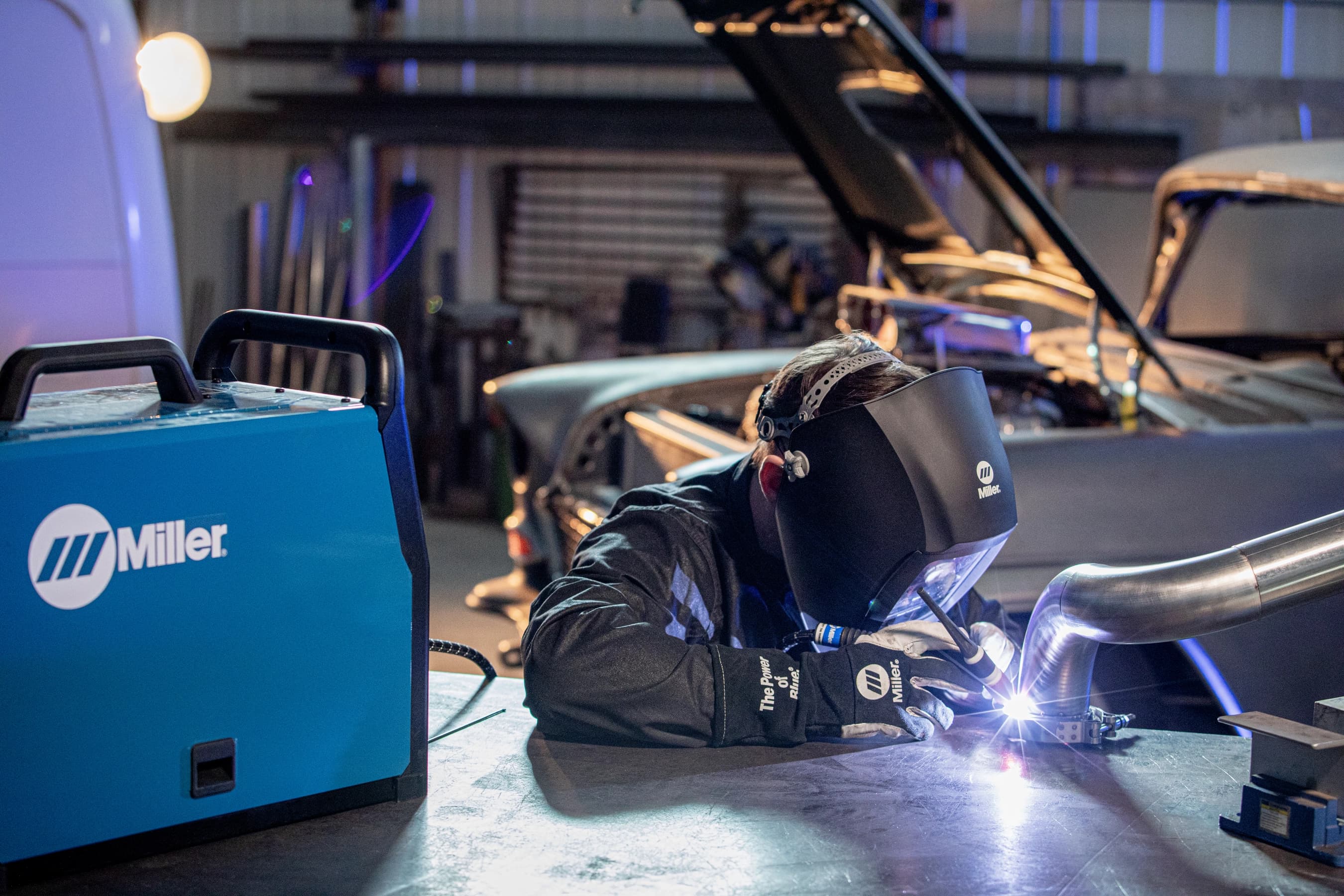
For many welders, TIG is the skill that naturally follows MIG. If you’re already comfortable running a MIG welder, you understand joint prep, heat input and what a good weld should look like. But the difference between MIG and TIG welding isn’t really about difficulty but control and how you interact with the arc.
While TIG welding builds on the knowledge that MIG welders already have, it does come with a learning curve. The arc and overall process are fundamentally different, changing how heat is controlled, how filler is added and how the weld is managed. This article will help MIG welders understand what changes when switching to TIG and how the right equipment can make the transition more approachable and predictable.
When welders compare MIG and TIG welding, the conversation usually isn’t about which process is better. It’s about how much control the job demands and how much control the welder takes on at the arc. Both processes rely on proper technique. Even in MIG, the welder controls factors like travel speed and tip-to-work distance while using preset parameters as a guide. TIG welding shifts more of that responsibility to the welder. Instead of relying on preset settings alone, the welder actively manages heat input, filler addition and arc length, with more variables to control throughout the weld.
At a practical level, MIG and TIG welding differ in three key ways:
Understanding that difference helps explain why TIG equipment looks and operates differently than MIG.
One of the biggest adjustments MIG welders face when learning TIG is coordination. With TIG, the torch angle, filler metal and amperage are all controlled separately. In MIG, the welder can focus on a more streamlined process with fewer variables to manage. That added control in TIG means actively shaping the arc in real time, with more inputs to manage throughout the weld.
That’s where machine design makes a big difference. Successful TIG welding depends on three key factors: technique, proper machine parameters and the right consumables. A TIG machine built for ease of use and stable arc performance can simplify parameter setup and help guide consumable selection, so new welders can focus on coordination and puddle control instead of troubleshooting.
One of the biggest hurdles in learning TIG isn’t the process itself but setup uncertainty. Some TIG machines present new users with dozens of adjustable variables right away. Without experience, it’s difficult to know which settings matter and which ones can be left alone. That lack of clarity often leads welders to question whether a poor weld is caused by technique or by setup. Instead of overwhelming new TIG welders, certain features are designed to build confidence from the very first arc:
On light‑industrial TIG machines designed with learning in mind — like the Syncrowave® 212 — that predictable starting point helps welders separate technique issues from setup uncertainty as they build confidence.
Power selection is often one of the earliest points of confusion for welders moving from MIG to TIG.
That behavior is one of the reasons aluminum TIG welding challenges new welders. The puddle is more fluid, heat moves quickly through the material and small mistakes show up fast, often leading new TIG welders to misread surface oxidation movement as a true weld puddle.
Understanding how AC power behaves at the arc helps welders better interpret what they’re seeing. TIG power sources with stable AC and DC output deliver consistent arc behavior across materials, so welders can focus on developing technique instead of chasing settings.
As that confidence builds, TIG skills develop over time, and the right equipment should support that progression without getting in the way early on. A light‑industrial TIG machine like the Syncrowave® 212 is designed to meet welders where they are, supporting fundamental TIG learning while still allowing room to grow as experience builds.
As welders take on longer runs, more demanding materials or tighter cosmetic requirements, the ability to adapt becomes more important. Options such as water‑cooled torch capability and controls that go beyond baseline settings help support developing skills while maintaining arc stability and avoiding unnecessary complexity.
Features like Pro‑Set™ reinforce that learning‑first approach by making it easy to return to known, reliable settings. Being able to reset to a trusted baseline keeps the focus on technique rather than troubleshooting, allowing the machine to support the learning process as skills progress.
Learning TIG does more than add another process to a welder’s skill set. It deepens understanding of heat input, joint design and material behavior, which are all fundamentals that influence every type of welding.
Managing the arc directly helps welders become more intentional about puddle control and heat placement. That awareness often carries over to MIG and other processes, leading to better consistency, cleaner welds and improved decision‑making at the arc.
TIG skills also expand job opportunities. Welders who can confidently work with thinner materials, aluminum and specialty alloys often step into applications others can’t, reinforcing TIG as a complement to MIG rather than a replacement.
MIG welders already have a strong foundation. TIG builds on that experience, opening access to new materials, applications and higher‑skill work. With an intuitive TIG power source that’s designed to provide predictable arc behavior, straightforward controls and clear feedback, the transition becomes less intimidating and more rewarding. For those ready to take the next step, choosing equipment that supports confidence, predictability and understanding can make all the difference.
Posted Jul 7, 2026
TIG welding, also known as gas tungsten arc welding (GTAW) is a precision welding process known for producing clean, high-quality welds.
Learn about common mistakes when TIG welding as well as basic tips on how to prevent these errors.
Explore advanced aluminum welding methods, including in-depth guidance on MIG and TIG welding techniques. Get answers to complex questions and practical tips for industrial applications.