
Understanding Laser Welding Capabilities for Aluminum Applications
Andrew Pfaller
Product Manager and Weld Engineer
Why Aluminum Is Challenging for Laser Welding
Aluminum’s interaction with laser energy differs fundamentally from many other metals. In its solid state, it reflects a large portion of incoming energy, making it harder to initiate a weld. Once molten, however, absorption increases rapidly, allowing the process to stabilize.
Select modern handheld laser welders are designed around this transition. Rather than relying on operator intervention, these systems deliver controlled power density that consistently overcomes reflectivity, stabilizing the weld start and reducing variability from part to part.
How Modern Laser Welders Control Heat in Aluminum Applications
Beyond reflectivity, aluminum’s high thermal conductivity presents another hurdle. In conventional welding processes, heat can quickly move away from the weld zone, contributing to inconsistent penetration if energy input is not well controlled.
The high energy density of laser welding reduces this challenge compared to traditional processes, allowing heat to be delivered rapidly and precisely to the weld zone. Handheld laser systems intended for aluminum use engineered optics and focal strategies to concentrate energy where it is needed most, though weld integrity still depends on proper parameter selection, validation and ongoing process checks.
Improving Fit‑Up Tolerance in Aluminum Laser Welding
Laser welding has traditionally been associated with tight joint tolerances — something that can be difficult to achieve consistently with aluminum components. Small gaps can disrupt fusion if the process lacks flexibility.
Modern systems address this through advanced beam control and coordinated wire delivery that broaden the effective weld pool. These capabilities expand tolerance for minor fit‑up variation, giving shops greater flexibility when working with aluminum parts that may be difficult to fixture or vary slightly from piece to piece.
Shielding Gas Control for Reliable Aluminum Laser Welds
Effective shielding remains essential for aluminum laser welding, but modern systems are designed to reduce uncertainty. Stable, well‑controlled shielding delivery helps protect the molten weld pool and minimize the risk of internal defects, without requiring constant operator judgment.
As with any welding process, shielding effectiveness must be verified through proper setup, monitoring and quality checks to ensure weld integrity is maintained.
Cleanliness and Process Control in Aluminum Laser Welding
Aluminum naturally forms an oxide layer that can trap surface contaminants, potentially introducing variability if left unmanaged. Cleanliness remains a critical part of aluminum welding and cannot be eliminated through equipment alone.
Rather than replacing standard validation practices, modern laser welding approaches integrate cleanliness, filler selection and parameter control into a broader, repeatable process framework. Consistent preparation, qualification and inspection remain necessary to ensure aluminum weld quality.
Pre‑Engineered Programs and Best Applications for Aluminum Laser Welding
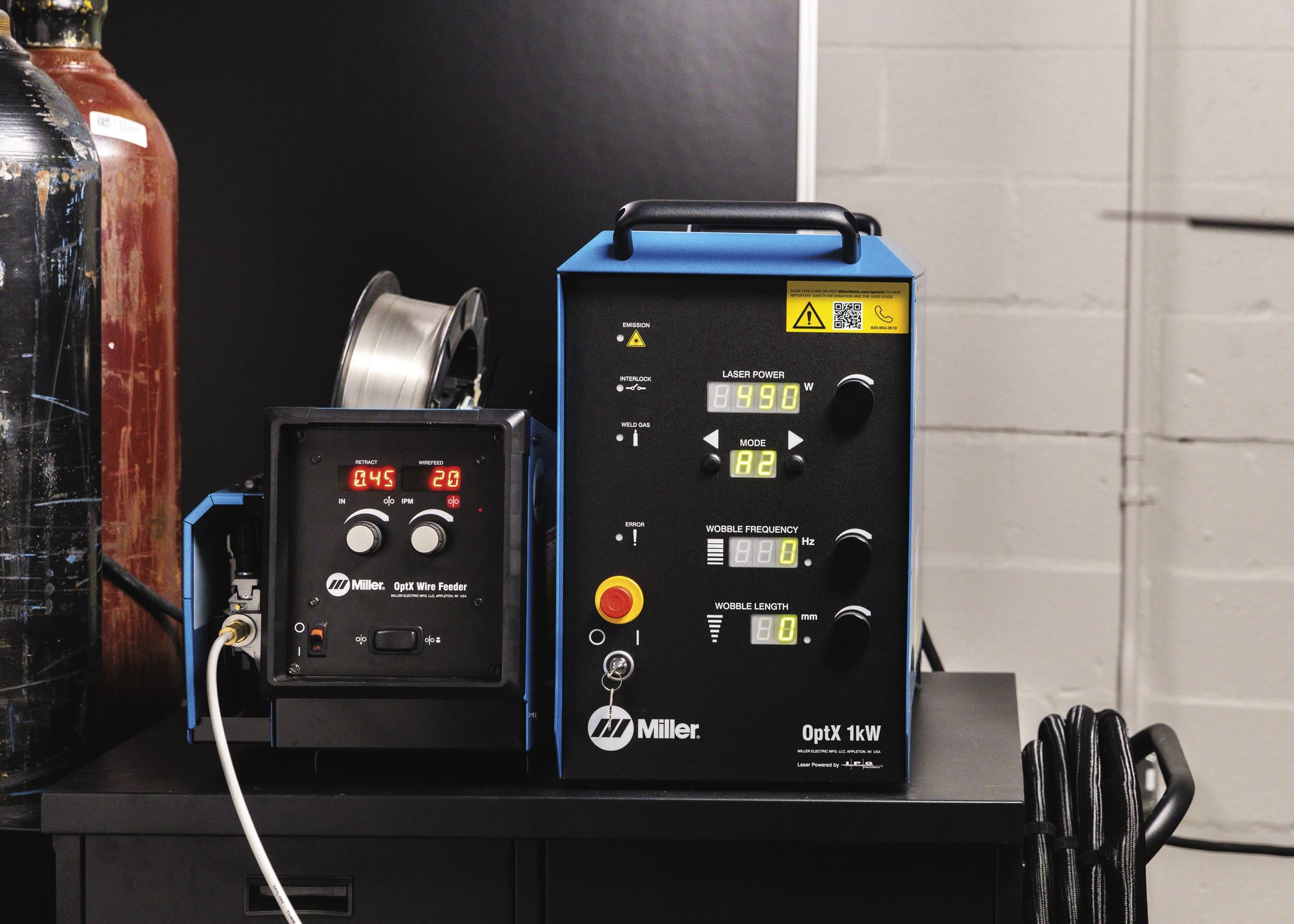
One of the strongest confidence builders in modern handheld laser welding, particularly with systems like OptX, is the use of pre‑engineered programs for aluminum applications. With systems like OptX, operators select the appropriate aluminum material and penetration thickness from established charts, then choose the corresponding program and laser power settings.
This structured approach helps reduce trial and error and lowers reliance on manual parameter development while still requiring operators to follow recommended settings and validation procedures. Laser welding is particularly well suited for thin‑gauge aluminum, decorative components, enclosures and precision assemblies where appearance and dimensional control matter most.
For heavier sections or applications that benefit from slower cooling and higher deposition, traditional MIG or TIG processes continue to play an important role. By adding handheld laser welding to their toolbox, shops can expand aluminum capabilities with greater confidence, using each process where it delivers the most value while reducing overall welding risk.
Key Takeaways
Modern handheld laser welding systems have made aluminum far more manageable by controlling the variables that once made it unpredictable. By stabilizing energy input, heat flow and process conditions, these systems improve consistency and reduce reliance on operator technique.
- Aluminum’s reflectivity and heat conductivity require precise control, which select modern laser systems such as OptX manage through stabilized energy delivery and engineered optics.
- Advanced beam control, shielding and pre‑set programs improve consistency, making weld outcomes more predictable and less dependent on operator skill.
- Laser welding expands aluminum capabilities — especially for thin, precision applications — while complementing MIG and TIG for heavier work.
Posted Jul 7, 2026